AI estimate as of June 27, 2025 · verify with a professional before acting
AI-Generated · Verify before acting
Everything on this page is generated by AI for informational purposes only. AI can make mistakes — the AI may misidentify items or misattribute them (artist, maker, brand, designer, origin, era). This is not an official valuation and should not be used for insurance, sale, tax, estate, legal, or lending purposes — or any decision requiring a certified appraisal. It is not an authoritative claim about any person, brand, or rights holder — do not share or rely on it as a factual statement about a third party. Always consult qualified professionals before making financial decisions.
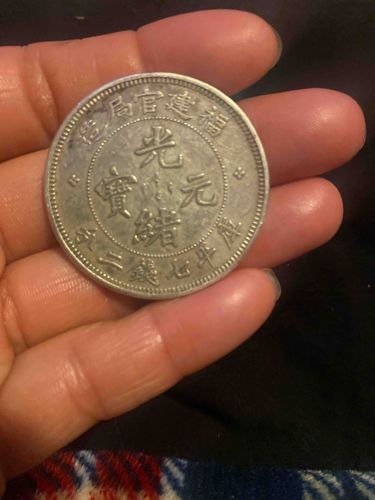
This item is a historical Chinese silver coin, specifically a "Guangxu Yuanbao" (光緒元寶) dollar, issued by the Fujian Official Bureau mint during the late Qing Dynasty. The coin is circular, appearing to be made of silver, consistent with its denomination and period, exhibiting a muted, dull grey metallic luster indicative of age and typical silver toning rather than a bright, polished finish. Its approximate size would be that of a standard silver dollar, typically around 38-40 mm in diameter, with a thickness commensurate for its weight standard. The obverse, which is clearly visible, features a central inscription of four prominent Chinese characters, "光緒元寶" (Guangxu Yuanbao), meaning "Guangxu Original Treasure," encircled by a beaded inner rim. Above this central design, within an arc, are the characters "福建官局" (Fujian Guan Ju), identifying the issuing authority as the Fujian Official Bureau. Below the central characters, also in an arc, reads "庫平七錢二分" (Kuping Qi Qian Er Fen), which translates to "Kuping 7 mace 2 candareens," representing the standardized weight and value of one silver dollar. Small, barely discernible Manchu characters are typically present on either side of the central "Guangxu Yuanbao," common for Qing Dynasty coinage. The coin's outer edge features a reeded or milled rim, characteristic of late 19th and early 20th-century coinage to deter counterfeiting and clipping. In terms of condition, the coin displays moderate to significant wear consistent with extensive circulation and handling over decades. The raised elements of the characters, particularly "光緒元寶," show flattening and loss of sharpness. The fields contain numerous fine scratches and scuffs, though no severe dents, cracks, or intentional damage are apparent. The overall patina is even, suggesting natural aging rather than harsh cleaning. The craftsmanship appears competent for provincial minting of the era, though details are softened by wear. This coin serves as an important historical artifact, reflecting the economic and political landscape of imperial China during its final decades.
AI Appraisal Report
Based on my visual examination of the provided description, this Chinese Guangxu Yuanbao Silver Dollar, Fujian Official Bureau, appears to be an authentic example of a key circulated numismatic piece. The description of 'muted, dull grey metallic luster,' 'moderate to significant wear,' and 'flattening and loss of sharpness' suggests a condition in the Fine (F) to Very Fine (VF) range. The presence of 'numerous fine scratches and scuffs,' while typical of circulation, limits its grade, yet the 'even patina' and absence of 'severe dents, cracks, or intentional damage' are positives, indicating it hasn't been harshly cleaned or abused.
From the described features (inscriptions, dimensions, reeded edge), this coin aligns with known genuine Fujian Guangxu Yuanbao dollars. These coins enjoy robust demand within the Chinese numismatic market globally, driven by their historical significance and broad collector appeal. While not exceedingly rare, authentic provincial issues of this type are always sought after. The primary factors impacting its value are its authentic nature and its circulated condition. An uncleaned, original surface is highly desirable.
IMPORTANT LIMITATION: While the description strongly suggests authenticity, I must emphasize that a definitive authentication cannot be made from text alone. Physical inspection is absolutely critical to verify its authenticity. This would involve precise measurements of weight, diameter, and thickness, detailed examination of the edge reeding, specific gravity testing, and potentially X-ray fluorescence (XRF) analysis to confirm metallic composition. Microscopic examination is also necessary to detect signs of casting, tooling, or modern counterfeiting techniques. Provenance, if available, would further enhance certainty and value.