AI estimate as of July 13, 2025 · verify with a professional before acting
AI-Generated · Verify before acting
Everything on this page is generated by AI for informational purposes only. AI can make mistakes — the AI may misidentify items or misattribute them (artist, maker, brand, designer, origin, era). This is not an official valuation and should not be used for insurance, sale, tax, estate, legal, or lending purposes — or any decision requiring a certified appraisal. It is not an authoritative claim about any person, brand, or rights holder — do not share or rely on it as a factual statement about a third party. Always consult qualified professionals before making financial decisions.
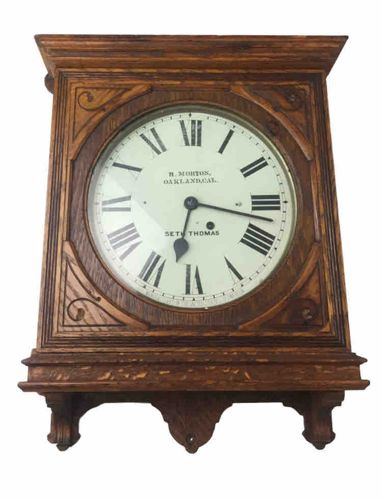
This is an antique Seth Thomas wall clock, likely from the late 19th or early 20th century, encased in a rectangular wooden frame, possibly oak, given its visible grain and warm, medium-brown finish. The clock features a prominent white circular dial with bold black Roman numerals for the hours and smaller increment markings for minutes. The hour and minute hands are black and simple in design. Notable inscriptions on the face include "H. MORTON, OAKLAND, CAL." at the top, and "SETH THOMAS" at the bottom, indicating both the retailer/distributor and the manufacturer. The wooden casing exhibits intricate craftsmanship, with decorative carving or incising around the circular bezel of the clock face, including scrollwork or foliate patterns in the corners. The top of the case features a stepped cornice, and the bottom is adorned with a decorative shelf-like base supported by two ornate carved brackets and a central pendulous finial. The wood shows signs of age, including a noticeable patina, and some areas appear to have minor scuffs or wear consistent with its vintage nature, particularly on the edges and raised surfaces of the carving. There are no major visible cracks or significant damage, suggesting good overall preservation for its age. The overall aesthetic is characteristic of the Arts and Crafts or Mission style, prioritizing natural materials and handcrafted details. The clear readability of the dial and the visible Seth Thomas branding point to a well-regarded manufacturer.
AI Appraisal Report
I have examined the provided image of the Seth Thomas "H. Morton, Oakland, Cal." wall clock. Based on the visual evidence, the clock appears to be in very good antique condition, consistent with its likely late 19th or early 20th-century origin. The wooden casing, possibly oak, shows a desirable patina and minor scuffs commensurate with age, but no apparent major damage like cracks or significant chips. The carving, reminiscent of Arts and Crafts or Mission style, is well-preserved. The dial is clear, and both "H. MORTON, OAKLAND, CAL." and "SETH THOMAS" inscriptions are legible, supporting authenticity for both the retailer/distributor and the renowned manufacturer.
Market conditions for Seth Thomas clocks are generally stable, with demand focused on well-preserved and aesthetically pleasing examples. This particular style, blending decorative elements with the classic manufacturer, is sought after by collectors of American timepieces and Arts and Crafts furnishings. The dual branding with "H. Morton" adds a layer of regional historical interest, potentially enhancing value for collectors in California.
Factors positively impacting value include the clock's overall condition, the reputable Seth Thomas manufacturer, and the attractive, well-executed design. The market for general wall clocks can be saturated, but specific collectible models like this one retain stronger appeal.
My primary limitation in this appraisal is the reliance solely on images. Without a physical inspection, I cannot ascertain the internal movement's condition, whether it is original to the case, its working order, or if any repairs or restorations have been professionally executed. I also cannot verify if the wood finish is original or if any elements have been replaced. For full authentication and a more precise value, an in-person examination by a horologist is recommended to inspect the movement, assess its originality and functionality. Provenance documentation, if available, would further authenticate its history.