AI estimate as of August 30, 2025 · verify with a professional before acting
AI-Generated · Verify before acting
Everything on this page is generated by AI for informational purposes only. AI can make mistakes — the AI may misidentify items or misattribute them (artist, maker, brand, designer, origin, era). This is not an official valuation and should not be used for insurance, sale, tax, estate, legal, or lending purposes — or any decision requiring a certified appraisal. It is not an authoritative claim about any person, brand, or rights holder — do not share or rely on it as a factual statement about a third party. Always consult qualified professionals before making financial decisions.
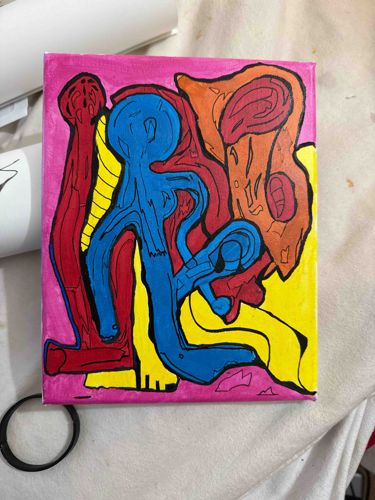
This is an abstract painting on a rectangular canvas, likely measuring approximately 8 to 10 inches in height and 6 to 8 inches in width, given its apparent size relative to the surrounding objects. The artwork features bold, vibrant colors, primarily fuchsia, red, blue, orange, and yellow, outlined with thick black lines. The composition consists of intertwining, biomorphic shapes that suggest organic forms or stylized figures, though no specific objects are clearly discernible. One prominent blue form in the center vaguely resembles a human figure, while other shapes are more amorphous. Colors are applied in solid, flat fields, indicating a technique that might involve acrylic or oil paints, though the matte finish suggests acrylics. The black outlines provide strong delineation and define the various elements of the composition, giving it a somewhat graphic or cartoon-like quality. The canvas edges appear painted fuchsia, suggesting the artist intended a wrapped or finished presentation. There are no visible signs of significant damage such as tears, punctures, or extensive paint loss, indicating good overall condition. The brushstrokes, where visible, appear smooth and even. No specific artist's signature, date, or other identifying marks are visible in the provided image. The style leans towards modern abstract art, possibly with influences from Cubism, Surrealism, or even Pop Art due to the bold colors and outlines. The age is difficult to determine without further information but appears to be contemporary (late 20th to 21st century). The craftsmanship is amateur to professional, with a clean application of paint and consistent line work.
AI Appraisal Report
Based on my visual examination of the provided image, this abstract biomorphic forms painting appears to be in good overall condition. There are no visible signs of significant damage such as tears, punctures, or extensive paint loss. The paint application seems clean and the black outlines are consistently applied, suggesting a reasonable level of craftsmanship. Authenticity cannot be definitively confirmed from images alone; without a signature or provenance, it's impossible to attribute it to a specific artist. The vibrant colors and bold biomorphic shapes place it within contemporary abstract art, reminiscent of styles from the late 20th to 21st century.
In terms of market conditions, the demand for unsigned contemporary abstract art of this scale and visual complexity from unknown artists is modest. While aesthetically pleasing, the lack of artist identification significantly impacts its marketability and value. Comparables would include similar unsigned decorative abstract works found in gallery or online marketplaces; these typically fall into a lower price bracket. Rarity is not a factor here as similar styles are prevalent. Factors significantly impacting value are primarily the absence of an identifiable artist and provenance. The piece functions more as a decorative item rather than a collectible.
For full authentication and a more precise valuation, an in-person examination would be crucial to assess paint quality, texture, and other physical characteristics not visible in photographs. Furthermore, any provenance documentation (e.g., purchase receipts, exhibition history) would be essential, and scientific testing (e.g., pigment analysis, dating techniques) could potentially determine its age and materials more accurately. Without these, the appraisal remains largely based on its decorative appeal and condition as a piece by an unknown artist.