AI estimate as of August 1, 2025 · verify with a professional before acting
AI-Generated · Verify before acting
Everything on this page is generated by AI for informational purposes only. AI can make mistakes — the AI may misidentify items or misattribute them (artist, maker, brand, designer, origin, era). This is not an official valuation and should not be used for insurance, sale, tax, estate, legal, or lending purposes — or any decision requiring a certified appraisal. It is not an authoritative claim about any person, brand, or rights holder — do not share or rely on it as a factual statement about a third party. Always consult qualified professionals before making financial decisions.
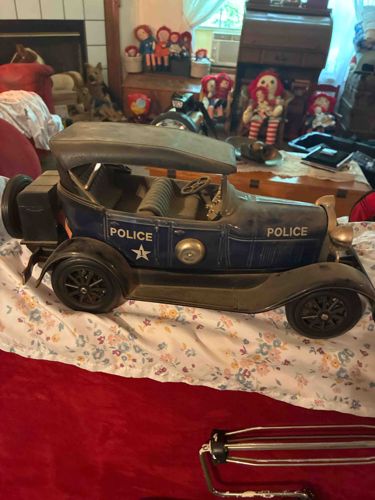
The item is a vintage police car toy, likely a pressed steel or tinplate construction, given its slightly dulled metallic sheen and the typical manufacturing methods for such toys from the early to mid-20th century. The primary color is a dark blue, possibly navy, with black accents on the fenders, wheels, and convertible top. The words "POLICE" are clearly visible in white block letters on both the front and rear sections of the side panel, separated by a white five-pointed star. This star, often associated with police badges or military insignia, reinforces its identity as a police vehicle.
The car features a classic early 20th-century automotive design, characteristic of models from the 1920s to 1940s, with prominent external fenders, a running board, and a somewhat boxy but streamlined body. The wheels appear to be solid black, possibly rubber-tired, with spoke or hubcap detailing. A spare tire is mounted on the rear. The convertible top is also black or dark grey, showing some signs of wear and possibly slight deformation.
Observable condition issues include general wear and tear consistent with age and use, such as paint chipping and scratches, particularly on raised edges and corners. There appears to be a notable amount of dust and grime accumulation, indicating it has been stored or displayed for a significant period without cleaning. The metallic surfaces show a patina of age, with some areas appearing duller or slightly oxidized. Despite the wear, the overall structure seems intact, with no obvious major breaks or missing large components. Internal details visible include a steering wheel and what appears to be bench seating, suggesting a passenger compartment. The craftsmanship appears robust, built for durability as a child's plaything, typical of collectible pressed steel toys from manufacturers like Buddy L, Structo, or Keystone.
AI Appraisal Report
I have examined the provided image of what appears to be a vintage pressed steel police car toy. Based on its design, material, and visible wear, it strongly resembles toys produced by manufacturers like Buddy L, Structo, or Keystone during the 1920s-1940s. The 'POLICE' lettering and star emblem are consistent with period police vehicles. Its authenticity as a genuine vintage piece is high given the characteristic paint chipping, patina, and overall construction that is difficult to replicate authentically in modern reproductions.
The condition, while showing significant paint loss, scratches, and grime, is typical for a well-played-with toy of this age. Crucially, the overall structure appears intact with no major breaks or missing components, which significantly aids its collectibility. The presence of a spare tire and interior details like the steering wheel adds to its completeness.
Demand for vintage pressed steel toys remains robust among collectors, with police and emergency vehicles often commanding a premium due to their iconic status. Rarity is moderate; while many pressed steel toys were made, finding them in relatively intact condition with original paint (even if worn) can be challenging. Market comparables for similar condition police vehicles from prominent makers suggest strong interest.
Factors impacting value include the visible wear and grime, which reduce the 'mint' condition appeal. However, the intact structure and clear original markings mitigate this. Cleaning could improve its visual appeal but must be done carefully to avoid further paint loss.
My assessment for authenticity is based on visual cues only. For full authentication, I would require an in-person examination to check for maker's marks typically found on the chassis or undercarriage, assess the metal's gauge and construction quality firsthand, and potentially test paint composition. Provenance documentation, if available, would further solidify its history and authenticity.