AI estimate as of August 4, 2025 · verify with a professional before acting
AI-Generated · Verify before acting
Everything on this page is generated by AI for informational purposes only. AI can make mistakes — the AI may misidentify items or misattribute them (artist, maker, brand, designer, origin, era). This is not an official valuation and should not be used for insurance, sale, tax, estate, legal, or lending purposes — or any decision requiring a certified appraisal. It is not an authoritative claim about any person, brand, or rights holder — do not share or rely on it as a factual statement about a third party. Always consult qualified professionals before making financial decisions.
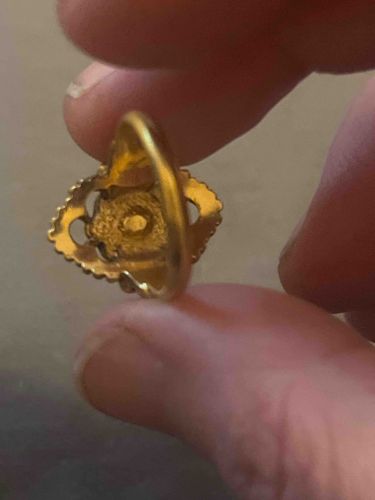
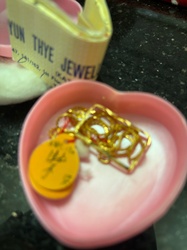
The item appears to be a vintage or antique gold-toned ring, judging by its overall design and the visible patina. The ring's band is relatively slender and simple, leading up to a decorative setting. The setting features an ornate, possibly filigree or openwork design on its underside, suggesting a commitment to craftsmanship beyond what is immediately visible from the top. The head of the ring is a distinct oval or navette shape, with a scalloped or beaded edge, indicating a decorative border. The color of the metal is a rich gold, which could be gold, gold-filled, or gold-plated, though without hallmarks, the exact material cannot be definitively determined. The condition shows some visible wear, particularly on the interior of the band and setting, where some surface dirt or discoloration is present. There are no obvious signs of significant damage such as bends or breaks, but detailed assessment of scratches or abrasions is difficult due to the image quality. The construction suggests a traditional jewelry manufacturing process, possibly hand-finished given the intricacy of the setting's backplate details. Although specific manufacturing marks are obscured, the overall aesthetic hints at a period style, potentially late Victorian, Edwardian, or early 20th century, given the ornate detailing often found in those eras. The primary design element, likely a gemstone or a decorative cabochon, is not clearly visible in the provided image.
AI Appraisal Report
I have examined the provided image of what appears to be a vintage or antique gold-toned ornate ring. Based on the visual evidence, the ring exhibits a design aesthetic consistent with late Victorian, Edwardian, or early 20th-century jewelry, characterized by its intricate filigree or openwork detailing on the setting's underside and scalloped bezel. The metal displays a rich gold hue, suggesting gold, gold-filled, or gold-plated material, though definitive authentication of the metal content is impossible without hallmarks or XRF testing.
The condition appears fair to good for its presumed age, with visible wear and patina, particularly on the interior of the band. There are no obvious major damages like breaks or significant deformities. The primary 'gemstone' area is indistinct in the image, which impacts a full assessment of its central feature.
From a market perspective, ornate vintage rings, especially those with visible craftsmanship, maintain steady demand. However, the exact market value is highly dependent on the metal's purity (karat gold vs. plating), the presence and nature of any central stone, and authenticated provenance. Without clear identification of the metal composition or the central element, and lacking hallmarks, the ring's value is significantly limited. If it were authenticated as solid gold (e.g., 10K, 14K) and featured a genuine gemstone, its value would rise considerably. Conversely, if it is gold-plated base metal with a glass or synthetic cabochon, its value would be primarily decorative and modest.
For full authentication and accurate valuation, an in-person examination is crucial. This would allow for:
1. **Hallmark identification:** To confirm metal purity and maker's marks.
2. **Metal testing:** Such as XRF analysis, to determine exact gold content.
3. **Gemstone identification:** To determine if the central element is a natural gemstone, synthetic, or glass.
4. **Detailed condition assessment:** Under magnification, to identify minor scratches, repairs, or structural weaknesses not visible in the image. Provenance documentation, if available, would also add significant value and authenticity.
Given the limitations of image-only appraisal, and assuming it is gold-filled or plated with an unknown, possibly non-precious, central element, its value is largely decorative.