AI estimate as of July 6, 2025 · verify with a professional before acting
AI-Generated · Verify before acting
Everything on this page is generated by AI for informational purposes only. AI can make mistakes — the AI may misidentify items or misattribute them (artist, maker, brand, designer, origin, era). This is not an official valuation and should not be used for insurance, sale, tax, estate, legal, or lending purposes — or any decision requiring a certified appraisal. It is not an authoritative claim about any person, brand, or rights holder — do not share or rely on it as a factual statement about a third party. Always consult qualified professionals before making financial decisions.
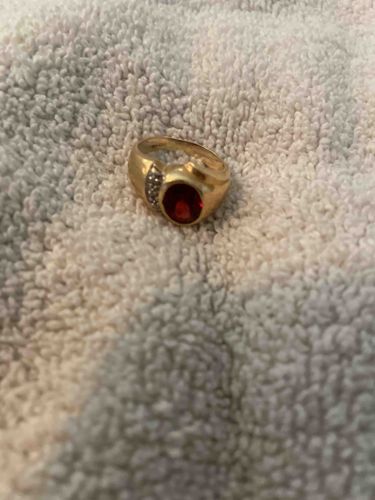
This item is a men's style signet ring, crafted from what appears to be a yellow gold-toned metal, possibly gold, gold-plated, or a gold alloy. The ring features a prominent, oval-shaped red cabochon-cut gemstone, likely a synthetic ruby, garnet, or colored glass, set flush into a bezel-like setting on the top face of the ring. To the left side of the main red stone, the ring's design incorporates three small, round, colorless stones, possibly diamonds, cubic zirconia, or glass imitations, set in a diagonal row, adding a contrasting sparkle. The band of the ring is broad and solid, exhibiting a somewhat chunky and substantial appearance consistent with men's jewelry. The metal surface appears to have a brushed or satin finish, with some areas showing signs of wear, including minor surface abrasions and possibly a slight dulling of the finish, which is to be expected from regular use. There are no clear maker's marks or hallmarks visible in the provided image, precluding identification of the manufacturer or precise metal content. The overall style suggests a mid to late 20th-century aesthetic, possibly from the 1970s to 1990s, characterized by bold designs and sometimes synthetic gemstones. The craftsmanship appears to be commercial grade, indicative of mass production rather than high-end custom work, but the setting for the stones seems secure. The condition is generally good, with typical wear consistent with its age and use, but no major damage or repairs are immediately evident.
AI Appraisal Report
Upon visual examination of the provided image, I assess this men's gold-toned signet ring to be in generally good condition, exhibiting typical wear consistent with its likely age and use. Authenticity, however, is a significant limitation based solely on imagery. The yellow gold tone could indicate solid gold, gold plating, or a gold alloy. Without hallmarks, density testing, or acid testing, the precise metal content cannot be definitively determined.
The prominent red cabochon stone appears to be a synthetic ruby, garnet, or colored glass, common in costume or mass-produced jewelry from the mid to late 20th century. The three accent stones, while appearing colorless, could be anything from genuine diamonds to cubic zirconia (CZ) or glass. Only a gemological examination using professional tools (e.g., refractometer, loupe, diamond tester) could confirm their identity. The setting appears secure, suggesting commercial-grade craftsmanship rather than high-end artisan work.
Market conditions for vintage men's rings of this type suggest a moderate demand, particularly if the golden tone is indeed solid gold. However, the lack of verifiable precious materials (gold, diamonds) significantly impacts value. Comparable pieces, if gold-plated or base metal with synthetic stones, typically retail in the lower range. If the metal is determined to be 10k or 14k gold and the accent stones are genuine, the value would obviously increase.
Factors significantly impacting value include the unknown metal purity, the identity of the gemstones, and the absence of maker's marks or provenance. Without an in-person examination to perform scientific tests on the metal and stones, and without any documentation of its history, a precise and confident appraisal is challenging. Full authentication would require a physical inspection by a jeweler to test the metal, and by a gemologist to identify the stones, as well as a search for any hidden hallmarks.