AI estimate as of December 16, 2025 · verify with a professional before acting
AI-Generated · Verify before acting
Everything on this page is generated by AI for informational purposes only. AI can make mistakes — the AI may misidentify items or misattribute them (artist, maker, brand, designer, origin, era). This is not an official valuation and should not be used for insurance, sale, tax, estate, legal, or lending purposes — or any decision requiring a certified appraisal. It is not an authoritative claim about any person, brand, or rights holder — do not share or rely on it as a factual statement about a third party. Always consult qualified professionals before making financial decisions.
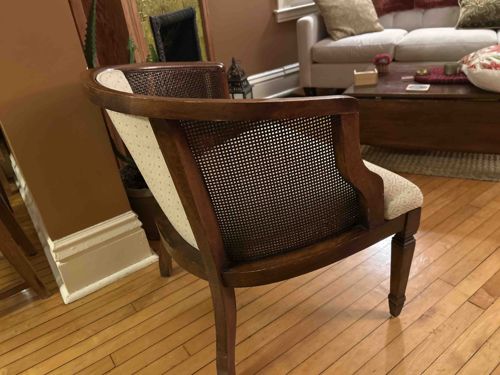
This is a cane back barrel armchair, likely from the Mid-20th Century or later, constructed predominantly from a dark-stained hardwood, possibly walnut or mahogany, showcasing a rich, warm brown tone. The chair features a distinctive barrel-shaped back and arms that flow continuously into the frame, providing an elegant and enveloping silhouette. The back panel is inset with a tightly woven cane material, exhibiting a consistent and well-maintained grid pattern. The upholstered seat and interior backrest are covered in a light-colored fabric, appearing to be a cream or very pale yellow, with a subtle textured or small-scale dotted pattern, suggesting a jacquard weave or similar upholstery. The armrests are solid wood, smoothly curved, and integrate seamlessly with the chair's overall design. The legs appear turned and tapered, culminating in a stylized foot, adding to its classic or transitional aesthetic. While the overall condition appears good from the visible angle, specific wear on the wood finish, upholstery, or caning cannot be fully assessed without closer inspection. However, the caning appears intact without significant tears or sagging, which often indicates good quality or careful maintenance. The craftsmanship suggests a commercially produced piece, potentially from a furniture manufacturer specializing in traditional or French Provincial inspired designs. The design blends comfort with a decorative appeal, making it suitable for various living spaces.
AI Appraisal Report
I have examined the image of this cane back barrel armchair. Based on its design, it appears to be a commercially produced piece from the Mid-20th Century or later, likely constructed from dark-stained hardwood such as walnut or mahogany. The overall condition, from visual assessment alone, appears good; the caning shows no obvious tears or sagging, which is a positive indicator. The upholstery, a light-colored fabric with a subtle pattern, also looks well-maintained. The legs are turned and tapered, adding to its classic aesthetic.
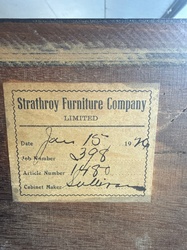
From a market perspective, cane back barrel armchairs are generally in moderate demand, particularly pieces that blend comfortable seating with decorative appeal. This style is quite versatile and can fit into various interior designs, from traditional to transitional. Comparables in the secondary market typically range depending on the designer, manufacturer, and precise condition. Without definitive maker's marks or provenance, it's challenging to attribute it to a high-end designer.
The main factors impacting its value are the overall good condition of the caning and upholstery, which are often points of significant wear in such pieces. However, its commercial production rather than bespoke craftsmanship, and the lack of a known designer, prevent it from reaching higher values. Rarity is not a significant factor here; similar styles were widely produced.
It is important to state that this appraisal is based solely on visual examination of the provided image. To fully authenticate its age, wood type, and confirm the absence of hidden damages or repairs, an in-person examination would be crucial. Physical inspection would allow me to assess the structural integrity, the true condition of the wood finish, upholstery wear not visible in the image, and any potential maker's marks or labels. Without such an inspection, the authenticity regarding specific claims of wood type or exact age remains an estimation.