These notes were written by the person who submitted this item. Appraiser.AI has not verified them, and the AI's identification and estimate may rely on them.
AI Estimated Value
Not an official valuation
$750-1,200
AI estimate as of July 10, 2025 · verify with a professional before acting
AI-Generated · Verify before acting
Everything on this page is generated by AI for informational purposes only. AI can make mistakes — the AI may misidentify items or misattribute them (artist, maker, brand, designer, origin, era). This is not an official valuation and should not be used for insurance, sale, tax, estate, legal, or lending purposes — or any decision requiring a certified appraisal. It is not an authoritative claim about any person, brand, or rights holder — do not share or rely on it as a factual statement about a third party. Always consult qualified professionals before making financial decisions.
This analysis also relies on unverified notes provided by the user, which may be incomplete or inaccurate and could affect the result.
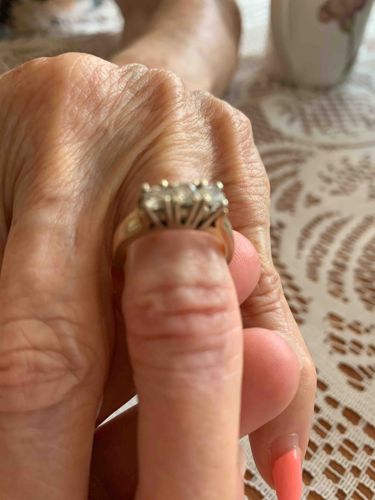
The item is a three-stone diamond ring, prominently featuring three round brilliant cut diamonds set in a yellow gold band with what appears to be white gold prongs for the diamonds, creating a multi-tone effect. The mounting style is a classic shared-prong or claw-prong setting, allowing maximum light into the diamonds. The diamonds appear to be of similar size, suggesting a uniform 'past, present, future' or trinity motif. The overall condition of the metal appears good, with a visible patina that suggests regular wear and an older age, but no obvious signs of significant damage such as deep scratches or deformation of the band. The gold shows some surface wear consistent with an item that has been worn over time. The craftsmanship appears to be of good quality, with the prongs securely holding the diamonds, although a closer inspection would be needed to assess stone quality and setting integrity. The diamonds exhibit sparkle and fire, indicating they are genuine, and their clarity and color would require professional assessment. Based on the style, it is likely from the mid-20th century, possibly 1950s-1980s, given the classic three-stone design and yellow gold preference of that era. There are no discernible maker's marks or signatures visible in the image. The ring is worn on an adult hand, which has some age-related skin characteristics.
AI Appraisal Report
Based on my visual examination of the provided image, this is a charming three-stone diamond ring crafted in yellow gold with white gold prongs, a common and attractive multi-tone approach. The classic three-stone design, often symbolizing 'past, present, future,' suggests a possible era of the mid-20th century, likely 1950s-1980s, aligning with prevailing yellow gold trends. The mounting appears to be a secure shared-prong setting, maximizing light entry into the diamonds, which exhibit good sparkle indicative of genuine material. The metal shows surface wear and a patina consistent with age and regular use, but no major damage or deformation is apparent. This suggests good durability and a piece that has been cherished.
In terms of market conditions, three-stone diamond rings remain consistently popular due to their timeless appeal and symbolic meaning. Demand is generally stable. However, the rarity of this specific piece is limited as similar designs are common. Factors significantly impacting value include the carat weight, color, clarity, and cut of each diamond, none of which can be definitively assessed from an image.
It is crucial to state that a full authentication and precise valuation are limited without in-person examination. I cannot definitively verify diamond authenticity beyond visual cues, nor can I determine their precise characteristics (4Cs), which are the primary value drivers. I also cannot confirm metal purity (e.g., 14k, 18k gold) or the presence of any hidden maker's marks or repairs. An in-person inspection would allow for measurement of diamond dimensions, weight estimation, examination of clarity under magnification, and color grading. Gemological testing would confirm diamond authenticity and treatments. A physical assessment would also verify the integrity of the settings and confirm metal purity. Provenance documentation, if available, could add historical or sentimental value.
Considering these limitations, this appraisal is based solely on the visual merits and assumes that the diamonds are natural and untreated, and the gold is likely 10k or 14k.