AI estimate as of August 9, 2025 · verify with a professional before acting
AI-Generated · Verify before acting
Everything on this page is generated by AI for informational purposes only. AI can make mistakes — the AI may misidentify items or misattribute them (artist, maker, brand, designer, origin, era). This is not an official valuation and should not be used for insurance, sale, tax, estate, legal, or lending purposes — or any decision requiring a certified appraisal. It is not an authoritative claim about any person, brand, or rights holder — do not share or rely on it as a factual statement about a third party. Always consult qualified professionals before making financial decisions.
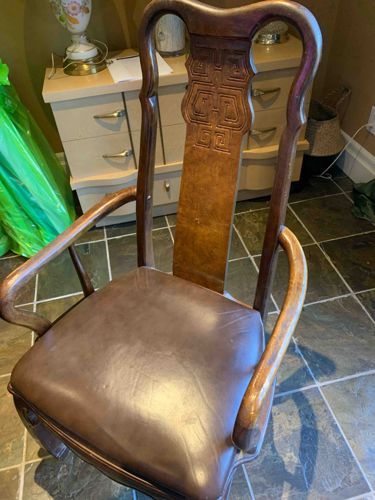
This is a vintage or antique Chinese-style hardwood armchair with an upholstered seat. The chair features a dark, rich brown wood, likely a dense hardwood such as rosewood or zitan based on its color and visible grain patterns, which give it a significant heft and durability. The backrest is particularly distinctive, presenting an intricately carved central splat with a geometric, perhaps 'shou' (longevity) or 'double happiness' symbol, motif characteristic of traditional Chinese design. The top rail of the backrest curves gracefully upwards and outwards, ending in subtle scrolls or rounded terminals. The arms are exceptionally elegant, beginning as extensions of the back legs, gradually curving forwards and downwards to meet the front of the seat frame, showcasing skilled joinery and steam-bent wood. The armrests are smooth and polished, exhibiting some wear and discoloration consistent with age and frequent use, particularly at the points where hands would rest. The seat is upholstered in a brown, possibly faux leather, material. It appears to be an overstuffed cushion, showing some indentations and minor creasing from use, but no major tears or rips are immediately visible. The overall construction suggests traditional joinery methods, lacking visible screws or nails from the exterior, which speaks to a higher quality of craftsmanship. The chair exhibits a visible patina across its wooden surfaces, indicative of age and handling. There are some minor scuffs and scratches on the wood, especially on the feet or lower areas, but no significant damage like cracks or breaks are apparent. The chair's design strongly aligns with Ming or Qing Dynasty furniture styles, specifically the 'scholar's chair' or 'master's chair' aesthetic, suggesting an estimated age from the late 19th to early 20th century, though it could be an earlier reproduction. Its robust construction and intricate carving are strong quality indicators.
AI Appraisal Report
Upon examining the provided images of this Chinese hardwood armchair, I am impressed by its strong aesthetic and craftsmanship. The chair's design is heavily influenced by classical Ming and Qing Dynasty 'scholar's chair' forms, characterized by the elegant, continuous curve of the arms and the carved central back splat. The dark, dense wood appears to be a high-quality hardwood, potentially rosewood (hongmu), though a definitive identification is impossible without physical inspection. The carving on the back splat, likely a stylized 'shou' (longevity) or similar auspicious symbol, is well-executed, suggesting skilled artisanship. The visible patina and minor wear on the armrests and lower legs are consistent with an age of late 19th to early 20th century. Condition appears good for its age, with only minor scuffs and no apparent structural damage. The upholstered seat is likely a later addition, which is common but affects value compared to an original woven seat. The market for high-quality Chinese antique furniture remains strong, particularly for well-proportioned and authentic pieces. However, its value is significantly contingent on its true age and material. Without physical examination to confirm the wood type, inspect joinery for modern tool marks, and assess the finish under magnification, I cannot definitively authenticate this as a period antique versus a high-quality 20th-century reproduction. Full authentication would require wood sampling or expert in-person analysis.