AI Appraisal Estimate

AI-generated estimates · not official valuations

From the user

What was submitted

Photo and notes provided by the user — not generated by AI

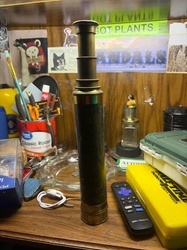
Submitted item photo
Submitted photo · June 26, 2026

User's notes

Metal

AI analysis below

AI appraisal

AI analysis & estimate

AI-Generated · Verify before acting

Everything below is generated by AI for informational purposes only. AI can make mistakes — the AI may misidentify items or misattribute them (artist, maker, brand, designer, origin, era). This is not an official valuation and should not be used for insurance, sale, tax, estate, legal, or lending purposes — or any decision requiring a certified appraisal. It is not an authoritative claim about any person, brand, or rights holder — do not share or rely on it as a factual statement about a third party. Always consult qualified professionals before making financial decisions.

Note

This analysis also relies on unverified notes provided by the user, which may be incomplete or inaccurate and could affect the result.

Read the full disclaimer

AI Identification

·Not independently authenticated·Verify before acting

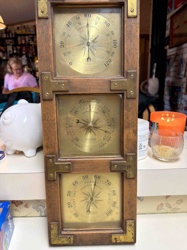
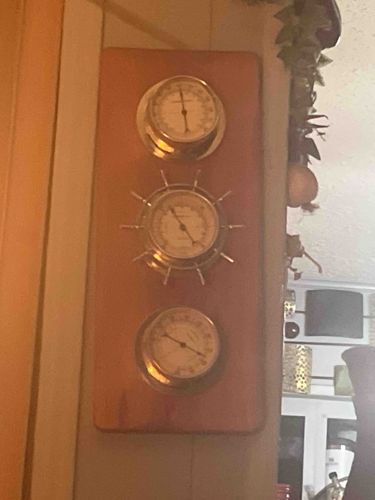
Vintage Nautical Three-Gauge Wall Weather Station

Scientific Instruments / Nautical Decor

AI Estimated Value

·Not an official valuation·Verify before acting

$45 - $85

As of June 26, 2026

AI Item Analysis

·AI can make mistakes·Verify before acting
This item is a wall-mounted vertical weather station featuring a trio of analog instruments vertically aligned on a solid wood plaque. The station typically includes a barometer for atmospheric pressure, a thermometer for temperature, and a hygrometer for humidity. The central instrument is distinctively styled with a decorative metal ship's wheel frame, emphasizing a maritime or nautical theme. The gauges are constructed with polished metallic housings (likely brass or chrome-plated metal) and circular white or cream-colored faces featuring black numerical markings and needle indicators. The wooden mount is rectangular with rounded corners, finished in a medium-toned reddish-brown stain. Based on the craftsmanship and specific design of the ship's wheel component, this piece likely dates to the mid-20th century, approximately the 1960s or 1970s. The overall condition appears fair to good, with some visible surface oxidation or patina on the metal housings suggesting age. There are no obvious cracks in the glass faces, though the wood shows standard signs of aging. The vertical orientation and mixed-material construction (wood and metal) make it a classic example of maritime-themed home decor from that era.
AI Appraisal Report

·AI can make mistakes·Verify before acting
Based on my visual analysis of this nautical weather station, I have identified it as a mid-20th-century mass-market decor piece, likely manufactured in the 1960s or 1970s. The set features a classic barometer, thermometer, and hygrometer arrangement. The central ship's wheel housing suggests it was intended for the 'den' or 'man cave' aesthetic popular during that era. The materials appear to be a combination of stained softwood and brass-plated pot metal or thin-gauge brass. Visual inspection shows moderate oxidation and pitting on the metallic finishes, particularly on the barometer housing, which is typical for items of this age but detracts from the 'mint' collectible value. Market demand for such pieces remains stable but modest. They are frequently found at estate sales and online vintage marketplaces. Rarity is low, as these were produced in high volumes by brands like Springfield, Taylor, or Airguide. The value is driven more by the 'nautical kitsch' appeal than by scientific precision. Factors limiting value include the oxidation noted and the fact that these analog sensors—specifically the hygrometer and barometer—often lose calibration over decades. Limitations to this appraisal: Authenticity and functionality cannot be fully verified via images. While the piece appears genuine to its period, a physical inspection would be required to determine if the barometer bellows are still intact or if the internal mechanisms are seized. To fully authenticate or increase its market profile, one would need provenance indicating a specific manufacturer or original box/manuals. Scientific testing of the metal composition would confirm if it is solid brass or merely plating, the latter being more likely for this style of domestic instrument.

Get your items appraised

Instant estimates of your treasures with AI-powered appraisals

Browse More Appraisals