These notes were written by the person who submitted this item. Appraiser.AI has not verified them, and the AI's identification and estimate may rely on them.
AI Estimated Value
Not an official valuation
$15-30
AI estimate as of July 22, 2025 · verify with a professional before acting
AI-Generated · Verify before acting
Everything on this page is generated by AI for informational purposes only. AI can make mistakes — the AI may misidentify items or misattribute them (artist, maker, brand, designer, origin, era). This is not an official valuation and should not be used for insurance, sale, tax, estate, legal, or lending purposes — or any decision requiring a certified appraisal. It is not an authoritative claim about any person, brand, or rights holder — do not share or rely on it as a factual statement about a third party. Always consult qualified professionals before making financial decisions.
This analysis also relies on unverified notes provided by the user, which may be incomplete or inaccurate and could affect the result.
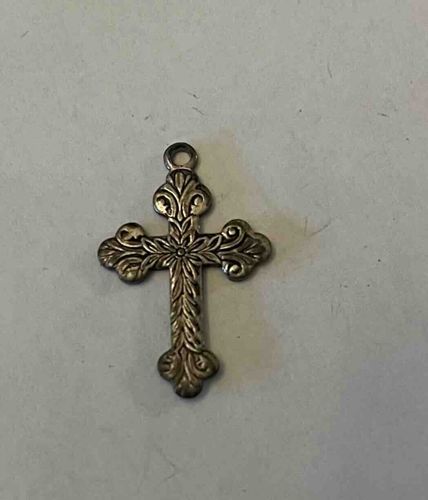
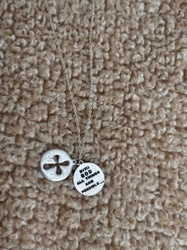
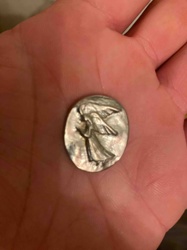
This is a small, ornate Christian cross charm or pendant, measuring approximately 2.25 cm in height and 1.5 cm in width. It appears to be constructed from a silver-toned metal, possibly sterling silver, silver-plated base metal, or pewter, given its slightly dull luster and the visible areas of darkened patina, particularly within the recessed areas of the design. The cross features a classic Latin cross shape with widened, floriated, or scrolled ends on each arm, consistent with a Baroque, Rococo, or Art Nouveau stylistic influence. The surface is extensively decorated with what appears to be a raised, repoussé, or cast floral and foliate motif. A prominent stylized flower, possibly a daisy or aster with multiple distinct petals, is centered at the intersection of the cross arms. The arms extending from this center are carved or molded with intricate leaf-like patterns and scrolls, which continue to the expanded tips of the cross. A small, circular bail or jump ring is integrally formed at the top of the upper arm, indicating its use as a charm, pendant, or component of a piece of jewelry such as a rosary or necklace. The condition shows a visible aged patina, suggesting it has not been recently polished, which enhances the intricate details by providing contrast. There are no obvious signs of significant damage like major dents, cracks, or repairs visible in the provided image, though the reverse side is not shown. The craftsmanship appears to be of good quality for a mass-produced or semi-mass-produced item, with clear detail in the design. Without a hallmark or maker's mark, its exact manufacturing origin and purity of metal are speculative, but its design suggests an age potentially from the early to mid-20th century, though similar designs are still produced today.
AI Appraisal Report
Upon examining the provided image of this Ornate Floriated Cross Charm/Pendant, I assess its condition as good, displaying a natural aged patina which, in fact, enhances the intricate details. There are no apparent signs of major damage or repair from this visual inspection. Its authenticity as a religious charm is clear, with its traditional Latin cross shape and florid decoration. However, without a physical examination, I cannot definitively confirm the metal composition; it appears to be a silver-toned base metal or low-purity silver due to the dull luster and visible tarnish. Verifying if it's sterling silver would require close inspection for hallmarks or metal testing.
Market conditions for religious charms of this type tend to be modest. Comparables in online marketplaces (Etsy, eBay) for similar mass-produced, vintage-style floriated cross pendants, particularly those of indeterminate metal, typically range from \$10 to \$40. Demand is consistent but not high, primarily from collectors of vintage religious items or individuals seeking wearable charms. Rarity is low as similar designs have been, and continue to be, widely produced.
Factors significantly impacting value include the metal purity (sterling silver would increase value slightly), precise age (true antique status rather than vintage-style reproduction), and any unique provenance. Without these, it's valued as a common decorative charm. Limitations in authenticity verification from images alone are significant; an in-person examination is crucial to identify hallmarks, thoroughly assess metal content, and confirm craftsmanship details not visible in a photograph. Scientific testing (e.g., XRF analysis) would be needed for definitive metal composition, and provenance documentation for historical context.