AI estimate as of August 31, 2025 · verify with a professional before acting
AI-Generated · Verify before acting
Everything on this page is generated by AI for informational purposes only. AI can make mistakes — the AI may misidentify items or misattribute them (artist, maker, brand, designer, origin, era). This is not an official valuation and should not be used for insurance, sale, tax, estate, legal, or lending purposes — or any decision requiring a certified appraisal. It is not an authoritative claim about any person, brand, or rights holder — do not share or rely on it as a factual statement about a third party. Always consult qualified professionals before making financial decisions.
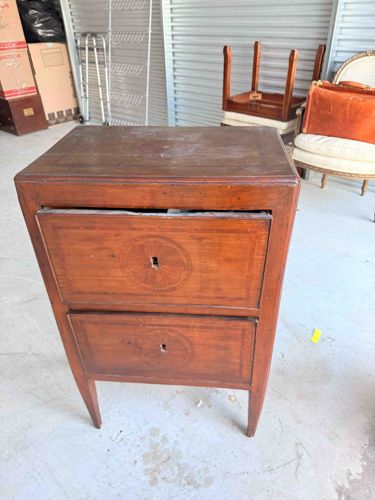
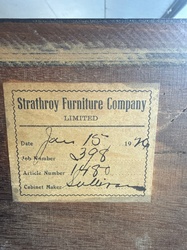
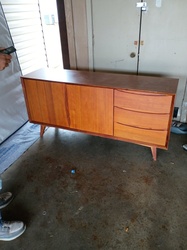
This item is a small, rectangular wooden chest of drawers, likely functioning as a bedside table or small commode. It appears to be constructed from a reddish-brown hardwood, possibly mahogany or cherry, with a visibly aged and somewhat worn finish. The top surface shows evidence of significant dust accumulation and some surface wear, including scratches and possible water marks, indicating a lack of recent maintenance or protection. The chest features two drawers, stacked vertically. Each drawer face is adorned with a centered, circular inlaid or carved motif, possibly a sunburst or geometric pattern, within which the keyhole escutcheon is located. The escutcheons themselves are simple, rectangular cutouts. The upper drawer is noticeably ajar, revealing a gap between the drawer and the cabinet frame, suggesting either ill-fitting joinery, warpage, or perhaps a lack of proper closure. The side panels of the chest blend seamlessly into slender, tapered legs, giving the piece a delicate and elegant profile. The overall style suggests a neoclassical or Biedermeier influence, placing its estimated age perhaps in the late 18th to early 19th century, though without clearer markings or construction details, this is an estimate. There are no visible maker's marks or signatures. The craftsmanship appears to be respectable for its period, with neat joinery evident in the framing of the drawers. The visible wear, particularly the dust and surface imperfections, indicates a need for restoration or cleaning. The lack of ornate hardware besides the keyholes suggests a focus on the wood's natural beauty and form.
AI Appraisal Report
Upon visual examination of the provided image, I assess this two-drawer wooden commode or bedside table. The piece appears to be crafted from a reddish-brown hardwood, exhibiting the characteristics of a late 18th to early 19th-century neoclassical or Biedermeier style, consistent with its tapered legs and minimalist design. The circular inlaid or carved motifs on the drawer faces add a distinctive detail, though their exact nature is unclear without closer inspection.
In terms of condition, the item shows significant signs of age and neglect. The top surface has visible dust accumulation, scratches, and potential watermarks, indicating a lack of recent care. The upper drawer being ajar suggests possible warpage, ill-fitting joinery, or simply improper closure. These condition issues will significantly impact its market value and necessitate professional restoration or cleaning to maximize its appeal. The absence of ornate hardware, apart from the keyhole escutcheons, emphasizes the wood's inherent beauty, which is a common characteristic of the suggested period.
Regarding authenticity, based solely on the image, the style and apparent construction methods are consistent with the period; however, definitive authentication is limited. To fully verify authenticity and precise dating, an in-person examination would be crucial to assess joinery techniques, wood species, and any hidden markings. Provenance documentation, if available, would also be invaluable. Scientific testing, such as dendrochronology for dating or chemical analysis of the finish, could provide further conclusive evidence.
Market conditions for period furniture are generally stable for pieces in good condition, but items requiring restoration often see reduced demand compared to 'ready-to-place' examples. Comparables include similar-sized European commodes of the early 19th century. The elegant profile and what appears to be solid craftsmanship lend it appeal, but its current state of preservation and the typical challenges of identifying specific makers without marks limit its rarity premium.
Considering its age, stylistic appeal, and the need for restoration, I would place its current appraisal value in the range of $600-$900. This value accounts for its antique nature and potential, offset by its current condition and the inherent limitations of appraisal based solely on imagery.