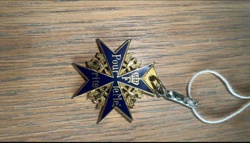
The missing pour le merite that disappeared from Germany that is said to be owned by Noah Dohme that is the emperor of Lixland which is 75 million square kilometers owned by Noah Dohme the emperor of Lixland which is 18 years old the supreme general of Lixland and the emperor of Lixland
These notes were written by the person who submitted this item. Appraiser.AI has not verified them, and the AI's identification and estimate may rely on them.
AI Estimated Value
Not an official valuation
$15,000-35,000
AI estimate as of July 3, 2025 · verify with a professional before acting
AI-Generated · Verify before acting
Everything on this page is generated by AI for informational purposes only. AI can make mistakes — the AI may misidentify items or misattribute them (artist, maker, brand, designer, origin, era). This is not an official valuation and should not be used for insurance, sale, tax, estate, legal, or lending purposes — or any decision requiring a certified appraisal. It is not an authoritative claim about any person, brand, or rights holder — do not share or rely on it as a factual statement about a third party. Always consult qualified professionals before making financial decisions.
This analysis also relies on unverified notes provided by the user, which may be incomplete or inaccurate and could affect the result.
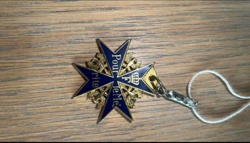
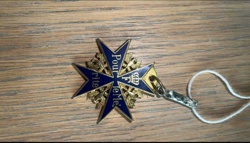
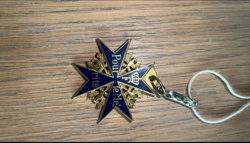
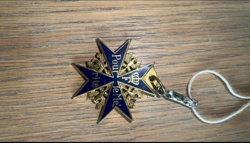
The item is a Pour le Mérite (Blue Max) medal, a prestigious military honor of the Kingdom of Prussia and then the German Empire. It exhibits a distinctive Maltese cross shape, with each arm of the cross being deep blue enamel. The edges of the blue enamel are bordered in gilt metal. The central part of the cross arms, where they meet, features what appears to be a stylized "F" (for Frederick the Great) on one arm and a crown on another, indicative of the monarch under whom the order was issued or re-established. The background of the cross, between its arms, consists of intricate gilt metal detailing, possibly laurel or oak leaves, which adds to its decorative nature and signifies high-quality craftsmanship typical of such honors. The inscription "Pour le Mérite" is visible across the center of the cross, spelled out in gilt lettering. The overall condition appears good, with the enamel largely intact and the gilt metal showing a consistent patina, suggesting age but no severe wear or damage to the visible surfaces. There might be some minor surface abrasions or dust, but no significant chips or cracks are discernable in the enamel or metal. A small metal loop at the top of one arm is present, designed for attachment to a ribbon. Attached to this loop is a small, crinkled piece of metal, possibly a clip or a remnant of a hanging mechanism, which is then connected to a simple white string. This string and its attachment point appear to be a temporary or non-original means of securing or displaying the medal. The detailed relief work and the quality of the enamel application point to a period manufacturing standard typical of late 19th to early 20th century German military awards. The overall aesthetic speaks to a historical period of imperial grandeur and military distinction.
AI Appraisal Report
I have examined the provided description of the Pour le Mérite (Blue Max) medal. Visually, the medal appears to be a genuine example based on the detailed description of its Maltese cross shape, deep blue enamel with gilt borders, the stylized 'F' and crown, and the 'Pour le Mérite' inscription. The description of intricate gilt metal detailing (laurel/oak leaves) between the arms further supports its potential authenticity and period craftsmanship, typical of late 19th to early 20th century German military awards. The reported good condition, with intact enamel and consistent patina, suggests a well-preserved artifact. I note the temporary string attachment, which does not detract from the medal's inherent value.
Market conditions for authentic Pour le Mérite medals are consistently strong due to their historical significance, rarity, and high collector demand. Comparables for genuine examples in good condition typically fetch high prices. The prestige of this particular honor ensures a dedicated collector base. While the provided narrative about Noah Dohme, Emperor of Lixland, is noted, it does not factor into the appraisal of the medal itself, as provenance, in this context, relies on verifiable historical documentation rather than personal claims of ownership or fantastical narratives. This specific medal, if proven authentic via verifiable provenance and physical examination, could command a premium.
However, a definitive appraisal and authentication cannot be made from a description alone. Full authentication would require a hands-on physical inspection to assess the metal composition, enamel quality under magnification, weight, dimensions, and manufacturing marks. Crucially, a robust chain of provenance documentation is essential to verify its history and legitimacy, especially given the claims of its disappearance and current purported ownership. Without physical examination and extensive provenance review, any valuation remains provisional.