AI identification & appraisal estimate

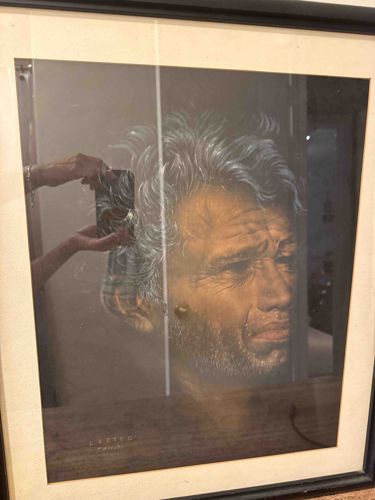
Edgar Leeteg 'Head of a Man' Oil on Black Velvet

Submitted photo of Edgar Leeteg 'Head of a Man' Oil on Black Velvet
Photo submitted by the user — not generated by AI

User's notes

Leeteg Tahitii

These notes were written by the person who submitted this item. Appraiser.AI has not verified them, and the AI's identification and estimate may rely on them.

AI Estimated Value

Not an official valuation

$4,000 - $6,500

AI estimate as of March 31, 2026 · verify with a professional before acting

AI-Generated · Verify before acting

Everything on this page is generated by AI for informational purposes only. AI can make mistakes — the AI may misidentify items or misattribute them (artist, maker, brand, designer, origin, era). This is not an official valuation and should not be used for insurance, sale, tax, estate, legal, or lending purposes — or any decision requiring a certified appraisal. It is not an authoritative claim about any person, brand, or rights holder — do not share or rely on it as a factual statement about a third party. Always consult qualified professionals before making financial decisions.

This analysis also relies on unverified notes provided by the user, which may be incomplete or inaccurate and could affect the result.

Read the full disclaimer

AI Item Analysis

This is a vintage portrait painting on black velvet, signed by the renowned artist Edgar Leeteg (1904–1953) with the inscription 'LEETEG TAHITI' visible in the lower left corner. The artwork depicts a middle-aged man with weathered facial features, white or silvering hair, and a somber expression, rendered in an earthy palette of browns and flesh tones contrasted against the deep black of the velvet substrate. The application of paint appears thin and skillfully blended to utilize the velvet's texture for shading and depth. The piece is housed in a simple rectangular black wooden frame with an off-white matting that shows some signs of age and yellowing. The painting itself exhibits remarkable craftsmanship typical of Leeteg, who is widely considered the 'father of American velvet painting.' Regarding condition, there is a visible vertical streak or reflection down the center of the glass which likely obscures some fine details, and the velvet surface shows some potential dust accumulation or minor fraying at the edges near the mat. The work appears to date from the mid-20th century, specifically the late 1930s or 1940s when Leeteg was active in Moorea, Tahiti. His signature style is evident in the realistic anatomical rendering and the dramatic chiaroscuro effect achieved through the interplay of oil pigment and light-absorbing fabric.


AI Appraisal Report

I have carefully examined the provided images of the oil on black velvet portrait 'Head of a Man,' signed by Edgar Leeteg. The work displays the hallmark technical proficiency of the 'father of American velvet painting,' specifically his mastery of thin oil glazes that allow the velvet's pile to provide mid-tones and shadows. The subject matter—an indigenous Polynesian figure—is consistent with Leeteg's most desirable Moorea period (c. 1933–1953). The signature and localization 'LEETEG TAHITI' appear consistent with known examples from the 1940s. While some matting yellowing and surface dust are present, the preservation of the velvet’s deep blacks is critical to its value. Demand for Leeteg remains strong among Tiki culture enthusiasts and collectors of South Pacific fine art. Comparables for authentic, well-preserved Leeteg portraits of this size typically hammer between $3,500 and $8,000 at specialized auctions. The primary factor limiting the current valuation is the obscured clarity due to glass glare and the lack of visible provenance. This appraisal is based on a visual digital inspection. Full authentication would require an in-person examination to verify the specific weave of the velvet, analysis of the paint's aging/fluorescence under UV light, and a search for original gallery labels or sales receipts from the Honolulu gallery (S. & G. Gump) that represented him. Without physical verification, there is a risk of this being a high-quality period imitation, which would significantly reduce the value.

Keep exploring

More fine art - paintings appraisals

Get your items appraised

Instant AI-powered appraisal estimates from a photo

Browse More Appraisals