AI estimate as of October 25, 2025 · verify with a professional before acting
AI-Generated · Verify before acting
Everything on this page is generated by AI for informational purposes only. AI can make mistakes — the AI may misidentify items or misattribute them (artist, maker, brand, designer, origin, era). This is not an official valuation and should not be used for insurance, sale, tax, estate, legal, or lending purposes — or any decision requiring a certified appraisal. It is not an authoritative claim about any person, brand, or rights holder — do not share or rely on it as a factual statement about a third party. Always consult qualified professionals before making financial decisions.
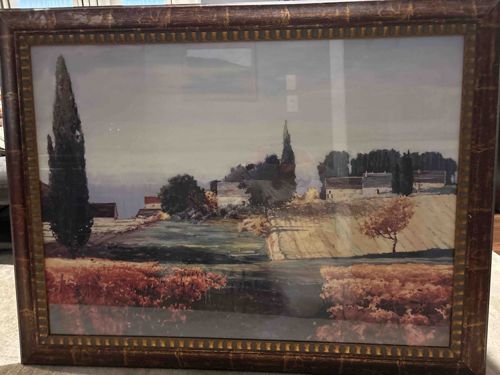
This item is a framed art print depicting a scenic Tuscan-style landscape. The print itself presents a serene rural scene featuring tall, dark green cypress trees, characteristic of the Mediterranean region, interspersed with what appear to be light-colored stucco or stone buildings, possibly farmhouses or villas, with darker roofs. The foreground shows fields with hints of cultivation, one appearing to be recently tilled or harvested in a golden-brown hue, and another area with lower, reddish-brown foliage, perhaps indicative of autumn or specific plant types. A small, sparse tree with reddish-brown leaves stands in the middle ground. The sky is a muted, light gray, suggesting either an overcast day or a soft, early morning/late afternoon light. While no explicit artist's signature or print marks are visible, the style suggests a reproduction of a landscape painting, possibly an oil or watercolor. The print is housed under glass within a rectangular frame. The frame is constructed of wood, or a material imitating wood, with a rich, dark brown, almost mahogany-like finish that features a distinct textured or mottled pattern, resembling aged leather or faux reptile skin. An inner border of the frame consists of a repetitive, small, golden or brass-colored beaded/ridged pattern, adding a touch of classical detail and visual separation between the print and the main frame. The overall condition appears to be good with no obvious major damage to the print itself, though reflections on the glass obscure some details and prevent a clear assessment of potential fading or yellowing. The frame appears sturdy, though minor scuffs or wear are possible given its age and handling. The style of the print and the frame suggests a decorative piece likely from the late 20th or early 21st century, intended for general household décor.
AI Appraisal Report
I have examined the provided image of the 'Framed Tuscan Landscape Print.' Based on my visual assessment, the print appears to be in good overall condition, with no overt damage visible on the print itself, though reflections on the glass prevent a conclusive determination of fading or yellowing. The frame, a dark brown, textured material with a gold-beaded inner trim, also appears sturdy. Authenticity is limited in this case; it is clearly a decorative print reproduction rather than an original artwork. Without a visible artist's signature, edition number, or publisher's mark, it is impossible to attribute it to a specific artist or printing house, which is common for mass-produced decor. This type of wall art is extensively available in various retail channels, both new and in the secondary market. Market conditions indicate a stable but low demand for such decorative prints. While aesthetically pleasing, the lack of rarity, artistic provenance, or unique features significantly impacts its value. Comparables for framed decorative prints of this nature typically range from $20 to $100 depending on size and frame quality. Factors impacting value are primarily its decorative appeal and satisfactory condition. For a full authentication that would be crucial for higher value items, I would require in-person examination to inspect the print medium, signature (if any), and frame construction, as well as any provenance documentation or scientific testing to determine print type or age. Without these, the value remains in the decorative arts category.