AI estimate as of November 9, 2025 · verify with a professional before acting
AI-Generated · Verify before acting
Everything on this page is generated by AI for informational purposes only. AI can make mistakes — the AI may misidentify items or misattribute them (artist, maker, brand, designer, origin, era). This is not an official valuation and should not be used for insurance, sale, tax, estate, legal, or lending purposes — or any decision requiring a certified appraisal. It is not an authoritative claim about any person, brand, or rights holder — do not share or rely on it as a factual statement about a third party. Always consult qualified professionals before making financial decisions.
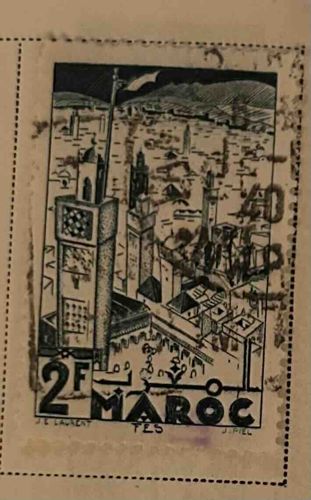
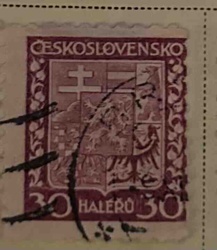
This is a vintage Moroccan postage stamp, likely from the mid-20th century, with a denomination of '2F' (2 Francs) and the country name 'MAROC' prominently displayed. The stamp features a detailed illustrative cityscape, dominated by a tall, distinctive clock tower on the left side, reminiscent of the Bab Bou Jeloud gate in Fes. The overall scene depicts a bustling urban environment with numerous buildings, minarets, and what appears to be a marketplace or courtyard at the base of the tower. In the background, rolling hills or mountains are visible under a clear sky. The artwork is characterized by fine line work and a monochromatic color scheme, primarily black print on a light, aged paper background, suggesting a lithographic or engraving printing process. There are visible perforations along the top, bottom, and right edges, though the left edge is somewhat irregular, potentially indicating it was either torn from a sheet or has been separated unevenly. The stamp exhibits signs of age and wear; the paper has a cream or light tan hue due to oxidation, and there are some minor creases or imperfections in the paper, particularly around the edges and corners. A faint purple or dark blue circular postmark is partially visible across the lower right portion of the stamp, obscuring some of the smaller text, confirming its use. The text 'J.L. LAURENT' is visible in the bottom left, likely the designer, and 'J. PIEL' in the bottom right, possibly the engraver or printer. Below 'MAROC' the word 'FES' is visible, clearly identifying the city depicted. The craftsmanship appears to be of good quality for stamp production of its era, with intricate details captured in the illustration despite the small format. The overall condition suggests it was previously mounted or stored with other stamps, showing typical wear for circulated philatelic material.
AI Appraisal Report
This Moroccan 2F 'MAROC FES' stamp, featuring the cityscape with a clock tower, appears to be a genuine vintage issue, likely from the early to mid-20th century, given the design, denomination, and visible printer/designer attributions (J.L. Laurent, J. Piel). The design strongly alludes to Fes, as indicated by the 'FES' text. Authenticity, based solely on visual examination of the image, seems plausible due to consistent design elements and printing characteristics for the era. However, without physical inspection, I cannot comment on paper type, watermark, or true printing method with absolute certainty.
The condition is circulated and shows typical wear for a used stamp. The faint partial postmark confirms its use, and while it adds historical context, a heavy postmark can detract from visual appeal. There are visible imperfections such as creasing, particularly at the edges, and color aging/oxidation of the paper. The irregular left edge suggests it was separated without particular care. These factors place it firmly in the 'used' and 'fine to very fine' condition range, rather than 'unused' or 'mint,' which would command higher prices.
From a market perspective, this is a relatively common issue for collectors of Moroccan or French colonial-era stamps. Demand is moderate, primarily from thematic collectors (cityscapes, clock towers, Arab world) or general country collectors. It is not considered particularly rare. Comparables for similar used examples of this stamp typically fall into the low double-digit dollar range. Factors impacting value negatively include the condition issues (creasing, aging, imperfect separation) and the partial postmark obscuring some details.
For a full authentication, physical examination is crucial to assess the paper quality, gum (if any remains), true colors, and potential watermarks. Microscopic analysis could confirm printing techniques. Provenance documentation (e.g., from a reputable dealer or previous collection) would also add to its verifiable history, though not strictly necessary for this common type.