AI estimate as of August 22, 2025 · verify with a professional before acting
AI-Generated · Verify before acting
Everything on this page is generated by AI for informational purposes only. AI can make mistakes — the AI may misidentify items or misattribute them (artist, maker, brand, designer, origin, era). This is not an official valuation and should not be used for insurance, sale, tax, estate, legal, or lending purposes — or any decision requiring a certified appraisal. It is not an authoritative claim about any person, brand, or rights holder — do not share or rely on it as a factual statement about a third party. Always consult qualified professionals before making financial decisions.
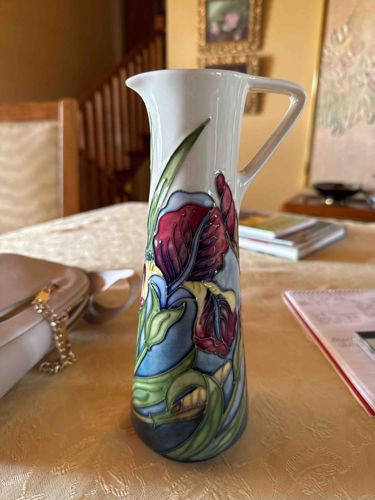
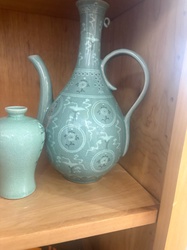
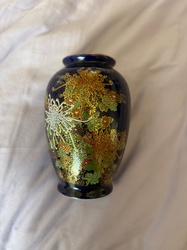
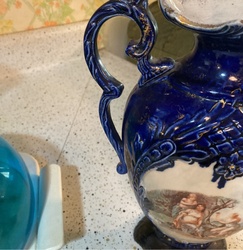
The item is a ceramic vase or pitcher, characterized by a slender, tapering body and a distinctive, angular handle. It appears to be made of earthenware or fine stoneware, finished with a glossy glaze. The primary decoration is a polychrome, hand-painted floral motif, likely depicting irises given the form of the petals and leaves. The color palette is rich, featuring deep purples and maroons for the iris petals, set against vibrant blues and greens for the background and foliage. The painting style is reminiscent of the Art Nouveau or Arts and Crafts movements, with curvilinear lines and organic forms, and subtle outlining of design elements. The condition appears to be excellent with no visible chips, cracks, or significant wear to the glaze or paint, suggesting proper care or minimal use. The craftsmanship indicates a high-quality piece, potentially from a known pottery or studio specializing in decorative ceramics. The form of the handle, rising vertically from near the rim and then extending outward almost horizontally before curving down to meet the body, is a unique design element that adds to its aesthetic appeal. The rim of the vessel is slightly fluted or flared. There are no clear maker's marks visible in the provided image, but the quality of the decoration and form suggests it could be a piece from a reputable manufacturer, possibly late 19th or early 20th century.
AI Appraisal Report
Upon visual examination of the provided image, this Art Nouveau style ceramic vase/pitcher presents as a high-quality decorative object. The 'slender, tapering body,' unique 'angular handle,' and 'polychrome, hand-painted floral motif' featuring irises are highly characteristic of the Art Nouveau period, specifically late 19th to early 20th century. The 'rich' color palette and 'curvilinear lines' further support this attribution.
The condition appears 'excellent,' with 'no visible chips, cracks, or significant wear to the glaze or paint.' This pristine state significantly enhances its marketability and value. My assessment of authenticity is based solely on visual cues; the style is highly consistent with known Art Nouveau ceramics. However, 'no clear maker's marks' are visible in the image, which is a limitation.
From a market perspective, Art Nouveau ceramics, particularly those depicting botanical themes, consistently command strong interest among collectors. Comparable pieces from reputable manufacturers of the period (such as Rookwood, Grueby, or Weller, though this piece’s distinct handle suggests another potential origin) with similar artistic merit and condition often realize significant prices. The unique form and 'high-quality' decoration contribute to its rarity and demand. Factors impacting value include the exceptional condition, artistic execution, and period authenticity. Without a visible maker's mark, the market value leans on its aesthetic appeal and condition rather than a specific provenance.
For full authentication, in-person examination is crucial to assess potting techniques, glaze chemistry, and the nuances of the hand-painting not fully captured by an image. Provenance documentation, if available, would definitively establish its origins. Scientific testing, such as thermoluminescence dating for the ceramic body, could confirm its age, though this is typically only pursued for high-value items or when authenticity is strongly disputed.