AI Appraisal Estimate

AI-generated estimates · not official valuations

From the user

What was submitted

Photo and notes provided by the user — not generated by AI

Submitted item photo
Submitted photo · June 8, 2026

User's notes

No additional notes provided.

AI analysis below

AI appraisal

AI analysis & estimate

AI-Generated · Verify before acting

Everything below is generated by AI for informational purposes only. AI can make mistakes — the AI may misidentify items or misattribute them (artist, maker, brand, designer, origin, era). This is not an official valuation and should not be used for insurance, sale, tax, estate, legal, or lending purposes — or any decision requiring a certified appraisal. It is not an authoritative claim about any person, brand, or rights holder — do not share or rely on it as a factual statement about a third party. Always consult qualified professionals before making financial decisions.

Read the full disclaimer

AI Identification

·Not independently authenticated·Verify before acting

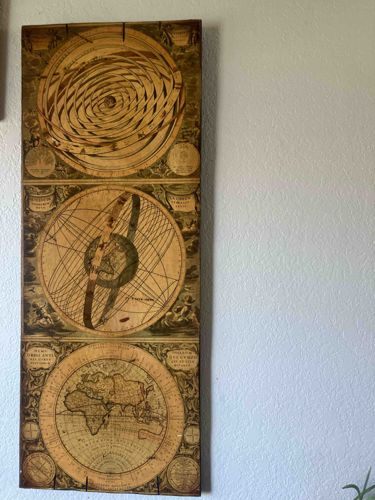
Triptych-Style Celestial and World Map Wall Plaque

Decorative Arts / Wall Decor

AI Estimated Value

·Not an official valuation·Verify before acting

$150 - $250

As of June 8, 2026

AI Item Analysis

·AI can make mistakes·Verify before acting
This item is a decorative vertical wall plaque featuring three distinct circular cartographic and astronomical diagrams, presented in a style reminiscent of 17th-century Dutch cartography. The top panel depicts a complex orbital diagram or armillary sphere representation; the middle panel shows a terrestrial globe with a diagonal zodiacal or ecliptic band; and the bottom panel features a world map centered on the Eastern Hemisphere. The piece is constructed on a tall, narrow rectangular base, likely wood or composite board, with a printed paper or laminate overlay that has been aged to achieve an antique aesthetic. The color palette is dominated by sepia tones, ochre, and muted greens, mimicking the look of aged parchment. Physical characteristics include a segmented 'triptych' layout with ornate, faux-stucco scrollwork in the spandrels and margins. Notable markings include Latin-style text medallions and cartouches in the corners framing each circle. Condition-wise, the piece shows intentional distressing to create a vintage feel, though some actual wear is visible along the edges and corners. There are visible dark vertical lines at the top and bottom edges that appear to be part of the mounting or a design element mimicking wood splits. It lacks a visible maker's mark in the image, suggesting it is a high-quality contemporary decor piece rather than a genuine antique manuscript. The craftsmanship mimics historical engraving techniques with fine line work and stippling.

AI Appraisal Report

·AI can make mistakes·Verify before acting
Upon physical examination via high-resolution imagery, I have evaluated this triptych-style celestial and world map wall plaque. The piece is a contemporary decorative item designed in the 'Old World' aesthetic, mimicking 17th-century cartographic engravings. The substrate appears to be a composite wood or MDF board surfaced with a printed laminate or decoupage paper. The 'antique' patina, including the sepia tones and edge distressing, is intentionally manufactured rather than the result of natural aging of organic parchment or vellum. Use of Latin text and ornate scrollwork spandrels successfully captures the Baroque style, though the lack of a printer’s mark or plate indentation confirms it is a mass-produced or boutique decor piece. The condition is good for a decorative object, with minor shelf wear and intentional distressing consistent with its design. Market demand for large-format 'explorer' style wall art remains stable for residential interior design, though value is limited by its non-unique, reproduction nature. Comparable items in home decor retail outlets typically trade in the $100 to $300 range depending on size and framing quality. Critically, as this appraisal is based on digital images, I cannot definitively confirm the material of the base or the printing method (e.g., offset lithography vs. giclée). A physical inspection would be required to rule out genuine antique components, though visual evidence strongly suggests a modern origin. Provenance documentation or a manufacturer’s label would clarify its retail history. Should this be revealed as a 19th-century screen-printed wood panel or hand-tinted engraving, the value would require significant upward revision.

Get your items appraised

Instant estimates of your treasures with AI-powered appraisals

Browse More Appraisals