AI estimate as of September 16, 2026 · verify with a professional before acting
AI-Generated · Verify before acting
Everything on this page is generated by AI for informational purposes only. AI can make mistakes — the AI may misidentify items or misattribute them (artist, maker, brand, designer, origin, era). This is not an official valuation and should not be used for insurance, sale, tax, estate, legal, or lending purposes — or any decision requiring a certified appraisal. It is not an authoritative claim about any person, brand, or rights holder — do not share or rely on it as a factual statement about a third party. Always consult qualified professionals before making financial decisions.
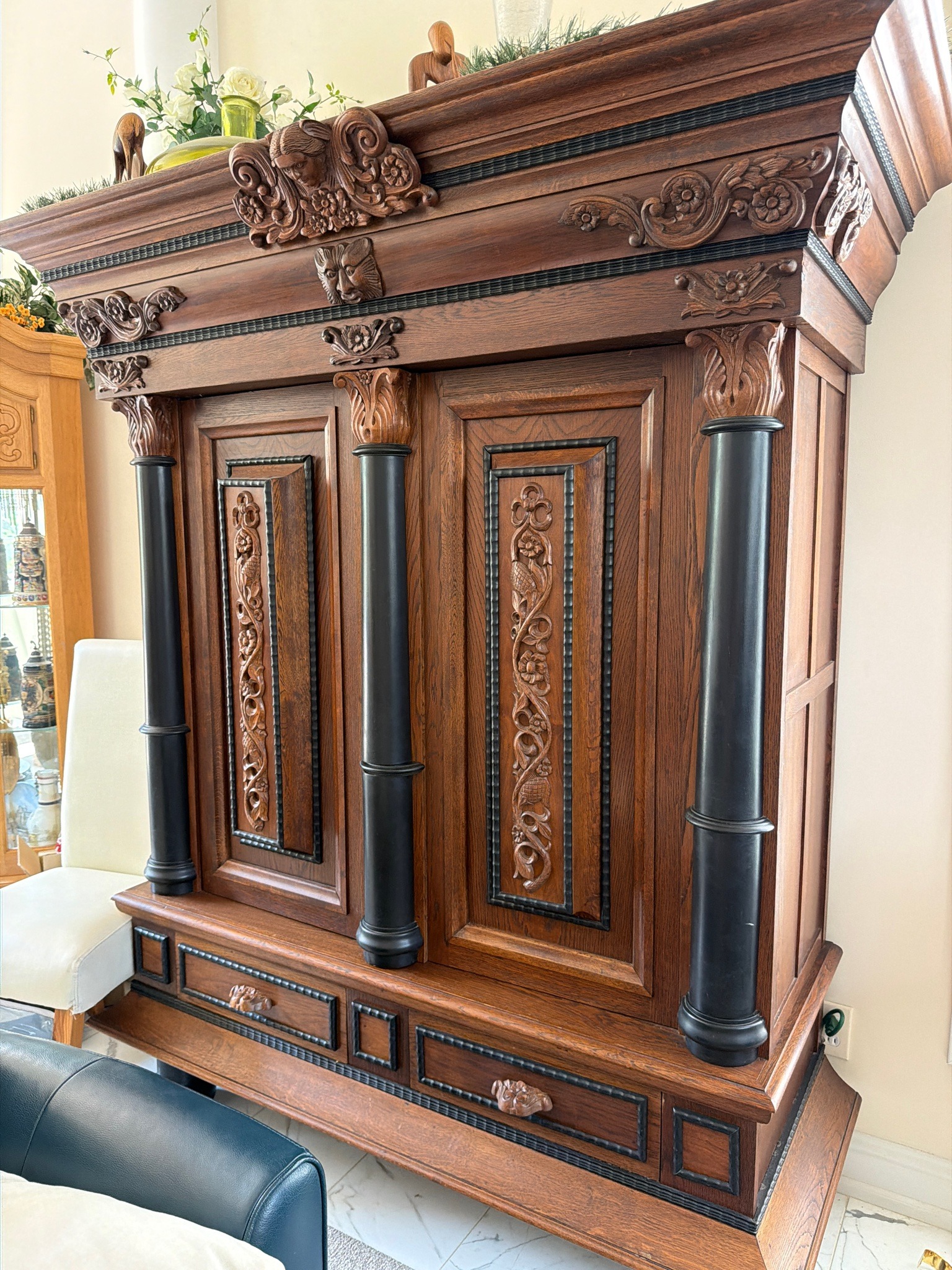
This large, freestanding storage cabinet displays prominent architectural and decorative elements characteristic of the 19th-century Renaissance Revival style. Constructed primarily from heavy oak with a rich medium-dark brown finish, the piece features contrasting ebonized or blackened architectural supports. The upper cornice is heavily ornamented with deeply carved scrollwork, floral motifs, and central figural carvings, including a stylized mask relief at the frieze center. The main facade consists of two large cabinet doors flanked by fluted and ring-molded black columns with carved Corinthian-style capitals. Each door features a recessed, paneled center inset with intricately carved vertical wooden panels depicting scrolling foliage and floral motifs, bordered by dentil molding. Below the doors are two horizontal drawers fitted with matching carved drawer pulls. The construction appears sturdy and utilizes traditional joinery techniques, though physical inspection is required to determine the exact age and internal framing methods. There are no visible maker's marks or signatures apparent in the image. The surface exhibits a warm patina consistent with aged furniture, with minor variations in wood grain and color. The overall craftsmanship suggests a high-quality production, possibly European, dating from the late 19th century, though exact attribution remains unverified.
AI Appraisal Report
Based on the visual evidence provided, I have evaluated this large, freestanding Renaissance Revival carved oak wardrobe cabinet, which appears to date from the late 19th century. Based on what I can see in the photograph, the piece displays characteristic features of the style, including heavy oak construction with a rich medium-dark brown finish, contrasting ebonized architectural supports, deeply carved scrollwork, and figural reliefs. However, I can't verify the exact age, internal framing methods, or wood species from a photo alone, and physical inspection is required to determine the structural integrity and traditional joinery techniques. There are no visible maker's marks or signatures apparent to suggest a specific workshop or manufacturer, leaving the attribution as a working hypothesis of European production from the late 19th century. The basis for my estimated value range of $2,500 to $4,000 assumes that the craftsmanship and materials are consistent with a quality 19th-century antique. General market demand for large, monumental antique furniture has softened in recent years, as modern home dimensions often struggle to accommodate such imposing pieces, which directly impacts current market behavior for items of this type. To confirm the age, condition, and potential value, an in-person examination by a qualified furniture conservator or specialist would be needed, alongside a thorough inspection for alterations or replaced elements. If this piece were to turn out to be a later reproduction, replica, copy, or made merely 'in the style of' the period rather than a period piece, the value would decrease significantly, likely dropping to a range of $800 to $1,500 depending on the quality of the craftsmanship. Value is strictly dependent on authentication, and an unauthenticated or later piece of this type would typically command a lower price in the secondary market.