AI estimate as of November 26, 2025 · verify with a professional before acting
AI-Generated · Verify before acting
Everything on this page is generated by AI for informational purposes only. AI can make mistakes — the AI may misidentify items or misattribute them (artist, maker, brand, designer, origin, era). This is not an official valuation and should not be used for insurance, sale, tax, estate, legal, or lending purposes — or any decision requiring a certified appraisal. It is not an authoritative claim about any person, brand, or rights holder — do not share or rely on it as a factual statement about a third party. Always consult qualified professionals before making financial decisions.
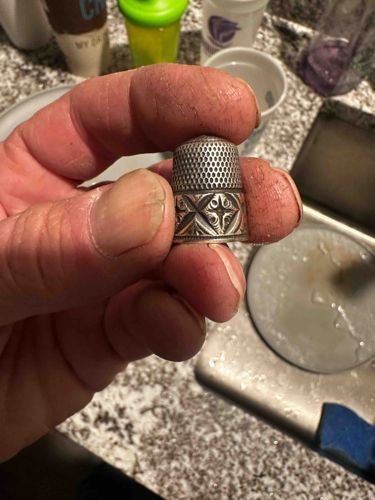
This appears to be an antique or vintage sewing thimble, crafted from a silver-toned metal, likely sterling silver given its appearance and the typical materials for decorative thimbles of this type. The thimble is small, designed to fit on a finger, with a conical shape leading to a domed top. The upper half, approximately two-thirds of the thimble's height, features a densely textured surface of small, regularly spaced indentations or 'dimples' which are characteristic of thimbles and provide grip for pushing needles. Below this textured area is a decorative band, roughly one-third of the thimble's height, which is intricately embossed with a repeating pattern. The pattern consists of alternating 'X' shapes and stylized four-petaled floral or star-like motifs resembling Celtic knots or similar ancient designs. This embossed band shows an 'antiqued' finish, with darker patination in the recessed areas, which highlights the detail and suggests age or an intentional aged aesthetic. The silver material exhibits a soft luster, suggesting some wear and handling over time, consistent with a utilitarian yet decorative object. There are no immediately visible cracks, major dents, or significant repairs, though minor surface scratches and natural tarnishing are to be expected with age. The craftsmanship appears to be of good quality, with clear, crisp embossing. Without visible maker's marks, it is challenging to ascertain the exact manufacturer or precise date, but the style suggests a late 19th to mid-20th century origin, aligning with periods where thimbles were both practical tools and collectible items.
AI Appraisal Report
I have examined the provided image of what appears to be an Antiqued Sterling Silver Thimble with an Embossed Band. Based on its visual characteristics, it presents as a genuine antique or vintage thimble. The soft luster, finely textured dimples, and intricate embossed band with an 'antiqued' finish are consistent with sterling silver examples from the late 19th to mid-20th century. The craftsmanship appears good, with clear embossing, and I observe no significant damage such as major dents or cracks, though typical minor wear and tarnishing are present, contributing to its authenticaged appearance.
Market conditions for collectible thimbles are steady, with demand often driven by niche collectors. While mass-produced thimbles fetch lower prices, those crafted from precious metals with distinctive designs or historical significance command more. This thimble's 'sterling silver' material (presumed) and decorative appeal elevate it beyond common utility thimbles, but without specific maker's marks or a truly rare design, its value remains moderate. Comparable pieces, often found in online auctions or specialized antique shops, typically range from $50 to $150 depending on condition, provenance, and exact material confirmation.
The most significant factor impacting value that remains unconfirmed is the material authenticity. Without a visible 'sterling' or '925' hallmark, or an in-person examination to test the metal (e.g., acid test, XRF analysis), I cannot definitively confirm it is sterling silver. It could potentially be silver-plated brass or another base metal, which would significantly reduce its value. Similarly, precise dating and manufacturer identification are impossible without hallmarks or provenance. Therefore, assuming it is sterling silver based on visual cues, I appraise this thimble in the range of $50 - $120. A physical inspection would be crucial to confirm material, search for faint hallmarks, and assess the true extent of wear.