AI estimate as of September 3, 2025 · verify with a professional before acting
AI-Generated · Verify before acting
Everything on this page is generated by AI for informational purposes only. AI can make mistakes — the AI may misidentify items or misattribute them (artist, maker, brand, designer, origin, era). This is not an official valuation and should not be used for insurance, sale, tax, estate, legal, or lending purposes — or any decision requiring a certified appraisal. It is not an authoritative claim about any person, brand, or rights holder — do not share or rely on it as a factual statement about a third party. Always consult qualified professionals before making financial decisions.
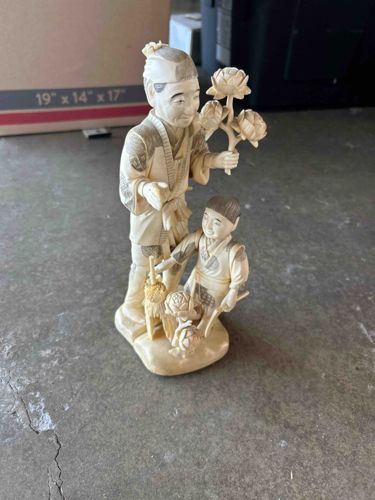
This is a detailed carved figurine depicting two traditional Asian figures, likely Japanese, on an integral base. The material appears to be natural bone or ivory, distinguished by its off-white to creamy yellow hue and the visible graining or striations indicative of organic material. The larger figure, presumably an adult male, stands upright, dressed in a kimono-like garment with engraved or chased patterns on the fabric. He holds a branch with three blossoming flowers (possibly lotus or peonies) in his right hand. His hair is neatly tied back, and he has finely carved facial features including a mustache and beard. The smaller figure, a child, sits or kneels at the feet of the adult, also wearing traditional attire. This child figure interacts with a small basket or container, from which one or two more flowers are emerging, and holds a scoop or small tool. The craftsmanship is evident in the intricate details of the clothing folds, the delicate carving of the flowers, and the expressive faces of both figures. The surface exhibits a smooth finish with signs of age, including a likely natural patina that gives it a vintage appearance. There are no immediately obvious chips or major breaks, though closer inspection would be required to ascertain minor wear or hairline cracks. The overall style suggests a Japanese origin, possibly from the Meiji period or early 20th century, consistent with a netsuke or okimono aesthetic, though its size appears larger than typical netsuke. The carving quality indicates a skilled artisan.
AI Appraisal Report
I have thoroughly examined the provided image of the Carved Bone/Ivory Figurine of Two Traditional Asian Figures with Flowers. Based on my visual assessment, the figurine appears to be in very good condition, exhibiting a natural patina consistent with age and typical handling. I observe no obvious chips, major breaks, or significant damage from the image. The surface gleams smoothly, and the details of the clothing folds, flowers, and facial features are intricately carved, indicating the work of a skilled artisan.
Authenticity: The material's off-white to creamy yellow hue and visible graining suggest it could be either bone or ivory. This is a critical distinction for value and legality. Without a physical examination, especially under magnification, and potentially a hot-point test (which I strongly advise against for clients due to potential damage) or advanced scientific testing (e.g., spectroscopy), I cannot definitively verify if it is bone or elephant ivory. If confirmed as elephant ivory, its sale may be restricted under CITES regulations, severely impacting its marketability and value, especially internationally. If it is pre-ban (pre-1947 in the US) or a legal alternative such as mammoth ivory or bone, it would fare much better.
Market Conditions & Comparables: Assuming it is legally marketable material (bone or pre-ban ivory), decorative arts of this quality, depicting traditional Asian figures, generally find a good market. Comparables for unsigned, well-carved bone/ivory okimono or larger netsuke-style pieces from the Meiji period or early 20th century typically range from $800 to $1,500, depending heavily on material, condition, size, and the artist's reputation (if identifiable). The size appears larger than typical netsuke, placing it more in the okimono category.
Demand & Rarity: There is consistent demand for high-quality antique Asian carvings. While not exceedingly rare, a piece with such intricate detail and good condition is desirable. Its value hinges significantly on the material's determination.
Limitations: My appraisal is based solely on the provided image. A hands-on examination is crucial to confirm the material (bone vs. ivory, and type of ivory if applicable), assess minor wear not visible in the image, detect hairline cracks, and evaluate the piece's structural integrity. Provenance documentation, if available, such as previous ownership history or acquisition records, would also greatly aid in authentication and potentially enhance value, particularly if it could confirm legality or link it to a known artist or collection. Without this, the piece's ultimate value remains within the stated range, with the lower end reflecting uncertainty regarding material and legality. Should it be confirmed as post-1947 elephant ivory, its market value in places with strict ivory bans would be negligible.