AI estimate as of November 25, 2025 · verify with a professional before acting
AI-Generated · Verify before acting
Everything on this page is generated by AI for informational purposes only. AI can make mistakes — the AI may misidentify items or misattribute them (artist, maker, brand, designer, origin, era). This is not an official valuation and should not be used for insurance, sale, tax, estate, legal, or lending purposes — or any decision requiring a certified appraisal. It is not an authoritative claim about any person, brand, or rights holder — do not share or rely on it as a factual statement about a third party. Always consult qualified professionals before making financial decisions.
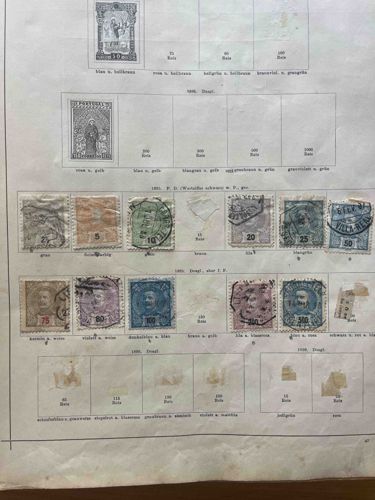
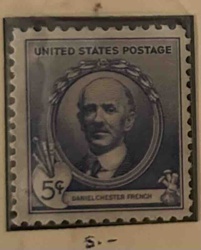
This item is a page from a vintage stamp album, meticulously organized with various adhesive postage stamps, predominantly featuring issues from Portugal. The page itself appears to be made of off-white or cream-colored heavy paper, likely from the late 19th or early 20th century, given the style of the stamps and the handwritten annotations. The page exhibits some discoloration and wear consistent with age, including slight browning around the edges and minor creasing. The stamps are affixed within printed boxes, some with German descriptions indicating their denomination, color, and period of issue (e.g., "1880. Dgl.").
The most prominent stamps are from Portugal, featuring portraits of either King Luis I or King Carlos I, alongside other designs. Colors observed among these stamps include various shades of brown, red, violet, blue, green, and yellow. Denominations visible range from 5 Reis, 10 Reis, 20 Reis, 25 Reis, 50 Reis, 75 Reis, 80 Reis, 100 Reis, 300 Reis, and 500 Reis. Several stamps show cancellations, indicating they were used for postage, while others appear unused or have very light cancellations. Some stamps exhibit visible wear such as minor tears, creasing, and discoloration, which is typical for items of this age that have been handled or circulated. The paper quality of the stamps themselves varies, reflecting the printing technology of the period. The arrangement suggests an organized collection, with spaces marked for additional stamps, some remaining empty. The overall condition reflects its age and use, serving as a historical record of postal services and philatelic interest.
AI Appraisal Report
I have examined the provided image of this vintage stamp album page. The page itself, likely from the late 19th or early 20th century, exhibits expected age-related wear including discoloration and minor creasing. The stamps are predominantly from Portugal, featuring King Luis I and King Carlos I, alongside other designs, within German-annotated boxes. Denominations from 5 Reis to 500 Reis are visible in various colors.
The condition of individual stamps varies; some show cancellations, indicating use, while others appear unused or lightly canceled. Wear such as minor tears, creasing, and discoloration is present on several, typical for circulated postage and early philatelic handling. The arrangement suggests an organized collection, though several spaces are empty.
From a market perspective, common 19th-century Portuguese stamps, even in organized groupings, typically do not command high values unless they are rare varieties, uncatalogued errors, or in exceptionally fine unused condition, which is not universally observed here. While some stamps appear to be in decent condition, others show significant faults that would detract from their individual value. The educational and historical appeal of such a collected page is notable, but financial value is largely tied to individual stamp rarity and condition.
Key factors impacting value here are the overall moderate condition, the commonality of the depicted issues, and the mixed status (used/unused) of the stamps. Without physical inspection, I cannot definitively assess gum condition on unused stamps, hinge remnants, or paper types, which are crucial for precise valuation. I also cannot verify for reperforations or repairs. Full authentication would require in-person examination to assess paper quality, watermarks, gum integrity, and any hidden faults. Provenance documentation would also be beneficial but is rarely available for such items.