AI estimate as of October 2, 2025 · verify with a professional before acting
AI-Generated · Verify before acting
Everything on this page is generated by AI for informational purposes only. AI can make mistakes — the AI may misidentify items or misattribute them (artist, maker, brand, designer, origin, era). This is not an official valuation and should not be used for insurance, sale, tax, estate, legal, or lending purposes — or any decision requiring a certified appraisal. It is not an authoritative claim about any person, brand, or rights holder — do not share or rely on it as a factual statement about a third party. Always consult qualified professionals before making financial decisions.
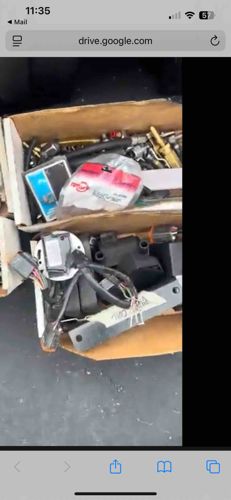
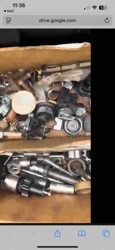
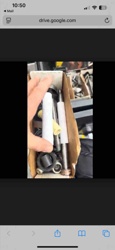
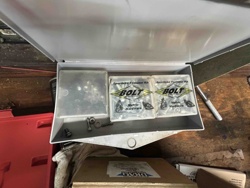
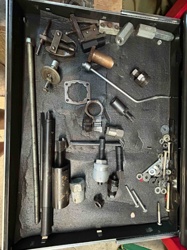
This item comprises a cardboard box filled with a diverse assortment of automotive and general hardware components. The box itself is a standard corrugated cardboard shipping box, showing some signs of wear, particularly at the edges, suggesting it has been handled or stored for some time. The contents are varied, making it difficult to pinpoint a single function. Prominently visible in the upper section are numerous small metallic parts, likely brass or chromed steel, such as fittings, connectors, and possibly small valves or nozzles. There are also plastic-bagged items, one of which appears to be a bag of 'Autocraft' branded electrical connectors or fuses, indicative of automotive or electrical repair. In the lower section of the box, larger, more complex components dominate. These include several black plastic modules, some with attached electrical wiring harnesses and multi-pin connectors, suggesting they are electronic control units, relays, or sensors from an automotive system. One particularly noticeable component has a gray-colored housing with a white label or sticker on it, though the text is illegible. Wires bundled with electrical tape or heat shrink are visible, indicating that some assemblies are intact. The condition of the components varies; some appear new in packaging, while others show signs of being used, with dust accumulation and minor surface abrasions. There are no clear manufacturer's marks or signatures universally visible across all components, suggesting they are a mixed lot from various sources or projects. The overall impression is that this is a collection of spare parts, project components, or inventory from a repair shop or hobbyist. The quality of individual components would range from standard mass-produced parts to potentially higher-grade electrical modules, depending on their original application. Without further inspection of individual items, precise age estimation is difficult, but the style of electrical connectors and packaging suggests a contemporary to recent manufacturing period, likely within the last 20-30 years.
AI Appraisal Report
I have examined the provided image of the 'Box of Assorted Automotive and Hardware Components.' The item presents as a varied collection of automotive and general hardware spares. The condition of the components appears mixed; some items, like the 'Autocraft' bagged electrical connectors, seem new or lightly used, while others, particularly the larger black plastic modules, show signs of previous use, dust accumulation, and minor surface abrasions. Authenticity is challenging to ascertain fully from an image. While the 'Autocraft' branding suggests genuine automotive parts, the lack of universal manufacturer marks across the entire lot prevents a definitive assessment for all components. Many appear to be generic, mass-produced items.
Market conditions for such mixed lots are typically driven by the potential utility of individual components rather than their collective appeal. Comparable items often appear on online auction sites (e.g., eBay) or surplus electronics/hardware outlets, where they are sold as 'parts lots' or 'maker bundles.' Demand for such an eclectic mix is generally low unless a buyer specifically needs several of the included generic components. Rarity is not a factor here; these are common mass-produced items. The primary factors impacting value are the unknown functionality of the electronic modules and the overall condition. Without testing, the larger modules are considered speculative, significantly reducing their individual worth.
Limitations in authenticity verification are significant. A physical inspection would be crucial to test the functionality of electrical components, identify specific part numbers on the modules for cross-referencing, and determine the exact material and quality of the metallic fittings. Without this, and provenance documentation (e.g., original purpose, source), the value remains relatively low due to the 'as-is, untested' nature of the collection.