AI Appraisal Estimate

AI-generated estimates · not official valuations

From the user

What was submitted

Photo and notes provided by the user — not generated by AI

Submitted item photo
Submitted photo · May 19, 2026

User's notes

No additional notes provided.

AI analysis below

AI appraisal

AI analysis & estimate

AI-Generated · Verify before acting

Everything below is generated by AI for informational purposes only. AI can make mistakes — the AI may misidentify items or misattribute them (artist, maker, brand, designer, origin, era). This is not an official valuation and should not be used for insurance, sale, tax, estate, legal, or lending purposes — or any decision requiring a certified appraisal. It is not an authoritative claim about any person, brand, or rights holder — do not share or rely on it as a factual statement about a third party. Always consult qualified professionals before making financial decisions.

Read the full disclaimer

AI Identification

·Not independently authenticated·Verify before acting

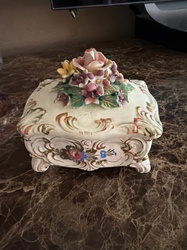
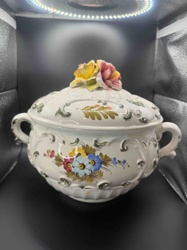
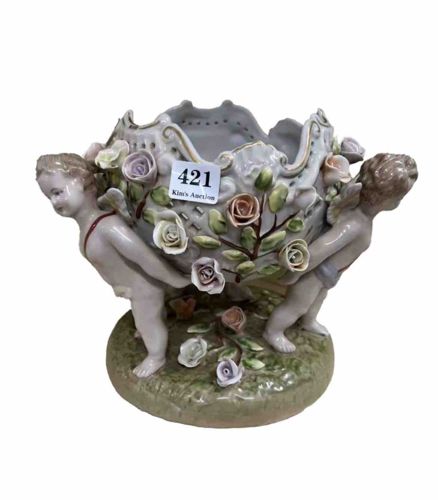
Dresden-style Capodimonte Porcelain Putti and Floral Centerpiece Bowl

Decorative Arts / Fine Porcelain

AI Estimated Value

·Not an official valuation·Verify before acting

$450 - $700

As of May 19, 2026

AI Item Analysis

·AI can make mistakes·Verify before acting
This is a decorative porcelain centerpiece bowl, likely of European origin, possibly Dresden or Capodimonte, featuring a highly ornate and classical Rococo-revival aesthetic. The piece consists of a wavy-edged, scalloped bowl decorated with delicate hand-applied porcelain roses and floral vines in shades of pastel pink, lavender, and white. Supporting the central vessel are two sculpted figures of putti (cherubs), modeled in a dynamic leaning pose with flesh-toned glazing and soft brown hair. The figures and the bowl are mounted on a grassy-textured circular base, which also features scattered floral elements. The bowl's rim is accented with gold gilt and perfoliation small-perforated details that add to its airy, delicate quality. Although a specific maker's mark is not visible in the photo, the level of hand-modeled floral work is characteristic of mid-to-late 19th-century or early 20th-century German or Italian porcelain art. Condition-wise, while the glaze appears largely intact with a high sheen, these pieces are notoriously fragile; close inspection reveals potential minor chips to the thin rose petals, which is common in antique floral porcelain. The overall craftsmanship suggests a high-quality decorative object meant for formal interior display.

AI Appraisal Report

·AI can make mistakes·Verify before acting
I have conducted a visual analysis of the provided decorative porcelain centerpiece. The item exhibits stylistic hallmarks of German Dresden or Italian Capodimonte porcelain, specifically within the Rococo-revival tradition. The hand-modeled floral encrustations and the anatomical rendering of the putti suggest a late 19th to early 20th-century production. The glaze displays a period-appropriate luster, and the gilded accents remain visibly vibrant. Market demand for 'encrusted' floral porcelain has leveled off from its peak in the late 1980s, but high-quality examples with figural elements remain desirable for traditional interior designers. This piece is particularly susceptible to 'flea bites' or losses to the delicate rose petals; upon close inspection, there appear to be minor chips consistent with age, which prevents it from reaching the premium $1,000+ bracket. Comparables for unsigned but high-quality floral centerpieces of this size typically hammer at auction between $400 and $800, depending on the integrity of the porcelain vines. A significant limitation of this appraisal is the absence of a maker’s mark (such as a blue 'AR' or crowned 'N'), which would definitively pinpoint the manufactory. Authentication from images alone is preliminary. To provide a final valuation, an in-person examination is required to check for invisible professional restorations using UV light. I would also need to inspect the underside for incised model numbers and obtain provenance documentation to confirm the piece is not a mid-20th-century reproduction. Scientific testing of the paste—distinguishing between hard-paste (German) and soft-paste or frit (certain Italian variants)—would offer a more precise origin.

Get your items appraised

Instant estimates of your treasures with AI-powered appraisals

Browse More Appraisals