AI estimate as of October 8, 2025 · verify with a professional before acting
AI-Generated · Verify before acting
Everything on this page is generated by AI for informational purposes only. AI can make mistakes — the AI may misidentify items or misattribute them (artist, maker, brand, designer, origin, era). This is not an official valuation and should not be used for insurance, sale, tax, estate, legal, or lending purposes — or any decision requiring a certified appraisal. It is not an authoritative claim about any person, brand, or rights holder — do not share or rely on it as a factual statement about a third party. Always consult qualified professionals before making financial decisions.
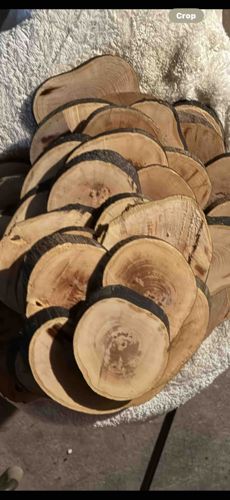
This collection consists of numerous natural wood slices, also commonly referred to as tree slabs or wood cookies, cut transversely from tree branches or small logs. The individual slices vary in shape, with most appearing circular or oval, and some exhibiting more irregular, organic forms. Each slice proudly displays its natural bark along the perimeter, which is dark brown to black in color, providing a striking contrast to the lighter, tan to light brown tones of the exposed wood grain. The cross-sections clearly reveal the concentric growth rings of the wood, indicating the age and growth patterns of the original tree. Some slices also show the central pith and ray structures characteristic of wood. The surfaces appear relatively smooth, suggesting they may have been machine-cut, although the degree of sanding or finishing is not discernible from the image. No visible manufacturing marks, signatures, or stamps are apparent. Given the raw, unfinished appearance, these slices are likely intended for crafting, decorative purposes (such as coasters, centerpieces, or signage), or hobbyist projects. They appear to be in good, natural condition with no obvious signs of significant cracking, rot, or insect damage, although some natural variations in color and small imperfections related to the wood's growth are present. The quality is indicative of standard craft-grade wood with rustic appeal, likely recently cut due to the fresh appearance of the wood tone and bark.
AI Appraisal Report
Based on my visual examination of the provided image, the Assorted Wood Slices / Tree Slabs appear to be in good, natural condition, suitable for their intended craft and decorative purposes. There are no obvious signs of significant damage like deep cracks, rot, or active insect infestation, which is common for such raw wood products. The bark is intact on the perimeters, and the wood grain and growth rings are clearly visible, indicating their natural origin. The clean cuts suggest machine processing. Authenticity as natural wood slices is readily apparent; no specific verification beyond visual inspection is typically needed for items of this type, as they are not unique artistic creations but rather raw materials.
Market conditions for natural wood slices are stable, with consistent demand from crafters, DIY enthusiasts, and event decorators. They are widely available through craft stores, online marketplaces, and lumber suppliers. Comparables range from small individual coaster-sized slices to larger centerpiece-grade pieces, typically sold in packs or by size. The value is primarily driven by the quantity, size uniformity, wood species (if known, which is not here), and overall aesthetic quality. These appear to be common, unidentifiable wood, which fits the general craft market.
Demand is moderate and consistent, but rarity is low; these are mass-produced craft supplies. Factors impacting value include the quantity visible (which appears to be a decent-sized collection, perhaps 15-25 pieces), the average diameter of the slices, and the quality of the cuts and bark retention. The rustic appeal is a key selling point.
My appraisal is limited by the lack of information regarding the exact quantity, precise dimensions of individual slices, wood species, and the overall weight or bulk, which often determines pricing in this category. Without physical examination, I cannot confirm the exact smoothness of the cut surfaces, the presence of any minor imperfections not visible in the image, or the full extent of the sapwood/heartwood coloration. Furthermore, the longevity or potential for future cracking cannot be assessed without knowing if the wood has been properly seasoned or kiln-dried, although given the fresh appearance, it likely has not been extensively dried. My valuation assumes a typical craft pack of medium-sized, undried wood slices.