AI estimate as of July 12, 2025 · verify with a professional before acting
AI-Generated · Verify before acting
Everything on this page is generated by AI for informational purposes only. AI can make mistakes — the AI may misidentify items or misattribute them (artist, maker, brand, designer, origin, era). This is not an official valuation and should not be used for insurance, sale, tax, estate, legal, or lending purposes — or any decision requiring a certified appraisal. It is not an authoritative claim about any person, brand, or rights holder — do not share or rely on it as a factual statement about a third party. Always consult qualified professionals before making financial decisions.
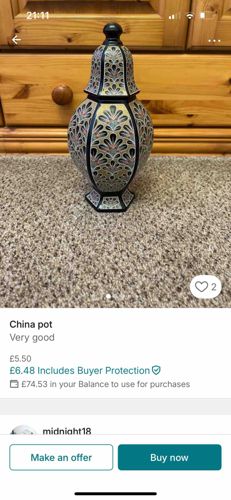
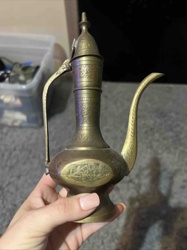
This appears to be a decorative lidded jar or urn, sometimes referred to as a ginger pot or a lidded vase. It features an ornate, intricate design, likely inspired by traditional Chinese or Asian motifs, though the term "China pot" in the listing may simply refer to its decorative style rather than its origin. The item has a bulbous body, tapering into a narrower neck, and is topped with a distinctively shaped lid, crowned with a finial. The primary colors observable are a dark tone, likely black or a very dark brown, serving as the background or outline for the detailed patterns. These patterns are rendered in lighter colors, possibly including beige, faded gold, and hints of pale blue and pink/red, creating a striking contrast. The design work is highly detailed, featuring repetitive floral or foliate motifs, possibly in a cloisonné, enamel, or painted relief style, though without closer inspection, the exact technique is difficult to ascertain. The base of the jar, as well as the mid-section of the lid, appears to be octagonal or faceted, adding to its structural interest. The overall condition appears "very good" as per the listing, with no obvious major damage, chips, or cracks visible from the provided image. The craftsmanship suggests it is a manufactured decorative piece, but the intricacy of the patterns implies a reasonable level of quality. There are no discernible maker's marks or signatures visible from the provided image, making it difficult to pinpoint its exact manufacturing origin or age definitively, but it likely dates to the 20th century.
AI Appraisal Report
Upon examining the provided image of this decorative lidded jar, I observe a piece with significant aesthetic appeal, featuring an ornate floral/foliate pattern, reminiscent of traditional Asian decorative arts. The item's condition appears very good, aligning with the listing's description. There are no immediate signs of chips, cracks, or significant wear visible from the photograph, suggesting it has been well-preserved. The intricate design work, whether cloisonné, enamel, or painted, indicates a good level of craftsmanship. Authenticity, based solely on this image, is limited to visual assessment. The lack of discernible maker's marks or signatures prevents definitive attribution to a specific artist, workshop, or precise period without in-person examination.
In terms of market conditions, items of this decorative style generally find a consistent, albeit niche, demand among collectors of Asian-inspired decor and decorative arts. Comparable sales of similar ornate lidded jars, often referred to as ginger jars or urns, in very good condition, typically fall within a modest range. Factors impacting value include the actual technique used (e.g., genuine cloisonné would command more than painted ceramics), the quality of the artistry, and the potential for a known manufacturer or older provenance.
While not exceptionally rare, well-preserved examples with appealing designs maintain their desirability. Without physical inspection, I cannot confirm the material composition, exact manufacturing technique, or detect subtle flaws not visible in the image. An in-person examination would allow for tactile assessment, detailed inspection for marks, and material analysis. Provenance documentation, if available, would significantly enhance authenticity and value, as would scientific testing to ascertain age and material composition if historical attribution were sought.