AI estimate as of September 1, 2025 · verify with a professional before acting
AI-Generated · Verify before acting
Everything on this page is generated by AI for informational purposes only. AI can make mistakes — the AI may misidentify items or misattribute them (artist, maker, brand, designer, origin, era). This is not an official valuation and should not be used for insurance, sale, tax, estate, legal, or lending purposes — or any decision requiring a certified appraisal. It is not an authoritative claim about any person, brand, or rights holder — do not share or rely on it as a factual statement about a third party. Always consult qualified professionals before making financial decisions.
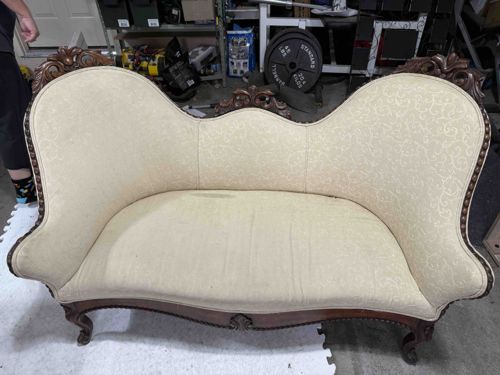
This is an antique or vintage sofa, likely a settee or courting bench, characterized by its distinctive 'fainting couch' or 'spoon back' design. The wooden frame, appearing to be finely carved dark wood, possibly mahogany or walnut, features ornate scrolled motifs at the top corners of the backrest and along the bottom rail. These carvings exhibit a high level of craftsmanship, indicative of a Rococo Revival or Victorian era style, most likely dating from the mid to late 19th century. The sofa is upholstered in a light-colored, possibly cream or ivory, fabric with a subtle repeating pattern, possibly a brocade or damask, suggesting elegance. The backrest is divided into two distinct, high-shouldered sections, creating a contoured profile, and the seat is a single, continuous cushion. The edges of the upholstered sections are accented with what appear to be decorative nailheads or trim, enhancing the detailed woodwork. The overall structure appears solid, with visible cabriole legs at the front that also feature carved details. The fabric shows some signs of wear and staining, particularly on the seat and lower backrest, consistent with age and use. There might be some minor scuffs or wear to the wooden frame, but it generally appears to be in good structural condition for its age. The quality of the carving and the overall design suggest a well-made, potentially high-end piece of furniture from its period.
AI Appraisal Report
Upon visual examination of the provided image, this Victorian Spoon Back Settee appears to be a genuine antique, likely dating from the mid to late 19th century, consistent with the Rococo Revival or Victorian era. The finely carved dark wood frame, exhibiting ornate scrolled motifs and cabriole legs, speaks to the craftsmanship of the period. The 'spoon back' design is characteristic and adds to its authenticity. The light-colored, patterned upholstery, while elegant, shows noticeable signs of wear, staining on the seat and lower backrest, and possible fraying or thinning in areas. This condition significantly impacts its value, as reupholstering is a considerable expense.
Market conditions for Victorian settees are currently moderate. While there's a steady demand for well-preserved period pieces, heavily worn upholstery like this often deters buyers looking for 'ready-to-place' items. Comparables for similar settees in good condition, with professional upholstery, typically fetch $1,200-$2,000+. However, given the reupholstery need, this piece falls into a lower bracket. Its rarity is moderate; while unique in its specific carvings, spoon-back settees are not exceedingly rare.
Factors significantly impacting value are primarily the upholstery condition and, to a lesser extent, any potential structural compromises not visible in the image. The high quality of the carving, however, is a positive attribute.
Limitations in authenticity verification from images alone are crucial. I cannot physically inspect the joinery, wood type definitively (e.g., mahogany vs. walnut), extent of any wood repairs or wormholes, or actual fabric texture and damage. Full authentication would require in-person inspection to assess structural integrity, identify the wood species, and confirm the method of construction. Provenance documentation, if available, would further solidify its history and origins, potentially enhancing its value. Scientific testing of wood or fabric fibers is generally not pursued for items of this commonality and value level unless there is substantial doubt or a claim of exceptional rarity.