AI estimate as of August 31, 2025 · verify with a professional before acting
AI-Generated · Verify before acting
Everything on this page is generated by AI for informational purposes only. AI can make mistakes — the AI may misidentify items or misattribute them (artist, maker, brand, designer, origin, era). This is not an official valuation and should not be used for insurance, sale, tax, estate, legal, or lending purposes — or any decision requiring a certified appraisal. It is not an authoritative claim about any person, brand, or rights holder — do not share or rely on it as a factual statement about a third party. Always consult qualified professionals before making financial decisions.
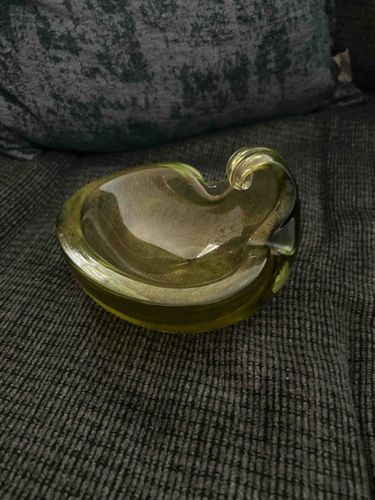
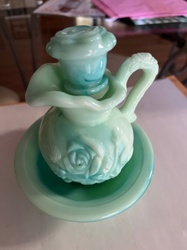
This appears to be a Mid-Century Modern art glass ashtray or catch-all dish, likely Venetian or Murano glass, given its characteristic smooth, organic form and rich color. The item is crafted from a translucent, olive-green or chartreuse-colored glass with a somewhat smoky or iridescent quality when viewed from certain angles, potentially suggesting an embedded metallic powder (aventurine) or specific glass fusion technique. Its design features a deeply recessed circular or oval basin, from which a pronounced, swirling, wave-like handle or protrusion rises on one side. This wave-like element is thick and sculptural, forming a natural rest, typical of ashtray designs from the period. The edges of the bowl are rounded and polished, indicating hand-finished craftsmanship. The overall shape is asymmetrical and organic, avoiding sharp angles. The base appears solid and slightly convex, contributing to its stability. There are no visible chips, cracks, or significant abrasions on the surface, suggesting good preservation. The glass exhibits a high degree of clarity and luster, with minimal visible imperfections or bubbles, which speaks to its quality. There are no discernible maker's marks or signatures visible in the provided image outside the basin or on the base, but such items often had paper labels that detach over time. The style points to a manufacturing period likely between the 1950s and 1970s, characterized by bold forms and vibrant colors in art glass.
AI Appraisal Report
I've examined the image of this Mid-Century Modern art glass ashtray/catch-all dish. Its organic, asymmetrical form and rich olive-green hue are highly characteristic of Venetian or Murano glass from the 1950s-1970s. The 'smoky' quality could be due to a specific glass frit or even aventurine, which was common. The absence of chips, cracks, or significant abrasions, along with its evident clarity and luster, suggests excellent preservation, which positively impacts its value.
From the image, authenticity appears strong for the period and style. These pieces were often unmarked, relying on paper labels that rarely survive. The craftsmanship, evident in the polished edges and sculptural handle, aligns with high-quality mid-century art glass. In terms of market conditions, there’s consistent demand for well-preserved Mid-Century Modern decorative arts, especially unique glassware. Comparable pieces, often generic Murano or Venetian, typically sell in the $100-$300 range, depending on size, color, and condition. The 'catch-all' functionality adds broader appeal than a dedicated ashtray.
Key factors impacting value here are the excellent condition and the attractive color. If this were definitively identified as a prominent Murano maker like Barbini or Seguso, the value could increase, but without a signature or label, that attribution is speculative. The rarity is moderate; while not a one-of-a-kind museum piece, it's a distinctive example of its type.
Limitations to my assessment from the image alone include the inability to: definitively confirm the glass composition (e.g., presence of aventurine), fully examine the base for hidden marks or wear, or assess the 'feel' and weight of the piece, both crucial for a complete appraisal. For full authentication, I'd need an in-person examination to look for faint pontil marks, assess internal flaws, and potentially conduct UV light testing or spectroscopic analysis if a specific maker's attribution was being challenged. Provenance documentation, if available, would also be invaluable.