These notes were written by the person who submitted this item. Appraiser.AI has not verified them, and the AI's identification and estimate may rely on them.
AI Estimated Value
Not an official valuation
$4,000 - $6,000
AI estimate as of July 17, 2025 · verify with a professional before acting
AI-Generated · Verify before acting
Everything on this page is generated by AI for informational purposes only. AI can make mistakes — the AI may misidentify items or misattribute them (artist, maker, brand, designer, origin, era). This is not an official valuation and should not be used for insurance, sale, tax, estate, legal, or lending purposes — or any decision requiring a certified appraisal. It is not an authoritative claim about any person, brand, or rights holder — do not share or rely on it as a factual statement about a third party. Always consult qualified professionals before making financial decisions.
This analysis also relies on unverified notes provided by the user, which may be incomplete or inaccurate and could affect the result.
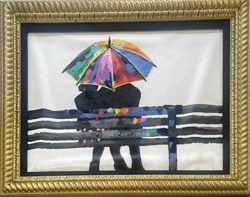
This is a vibrantly colored framed painting, likely executed in acrylics or oils on canvas or board. The artwork depicts a busy market or communal scene with multiple stylized figures, predominantly women, engaged in various activities, possibly carrying baskets or interacting within a group setting. The figures are rendered with distinctive facial features, including almond-shaped eyes and simplified noses, and are clad in flowing, brightly colored garments of yellow, red, blue, green, and white. The background is composed of large blocks of color, suggesting a minimalist and abstract approach to setting. A notable feature is the presence of several woven baskets, some appearing to be laden with goods. The overall artistic style is expressive and somewhat naive or folk-art inspired, yet exhibits a deliberate composition and careful use of color to create depth and movement. Visible craftsmanship details include defined brushstrokes, especially in the clothing and baskets. The painting is housed within a gold-toned, possibly wooden, frame that features a textured or distressed outer edge and a smooth, beaded inner lip, providing a classic border to the contemporary art. There are no obvious signs of significant damage like cracks or major abrasions to the paint surface; however, without closer inspection, minor wear or subtle patina associated with age cannot be entirely ruled out. The artist's signature, "Morel" (or potentially "Morel Doucet" as per context), is discernable in the lower right quadrant of the painting in white script, indicating a known artist. Given the artistic style and the provided context, the painting likely dates from the late 20th to early 21st century and might be indicative of a Haitian or Caribbean art tradition.
AI Appraisal Report
Upon examination of the provided image, this framed painting, signed 'Morel' and attributed to Morel Doucet, presents as a vibrant and well-executed example of his signature style. The artwork, likely acrylic on canvas or board, is in very good condition based on visual assessment, with no apparent tears, cracks, or significant abrasions. The color saturation remains strong, and the composition is dynamic, typical of the artist's work which often explores themes of the Black diaspora and Caribbean folklore. The signature appears consistent with known examples, but a definitive authentication cannot be performed from an image alone. In-person examination to assess the texture, medium layering, and reverse side of the canvas is essential. Furthermore, full authentication would require provenance documentation, such as a bill of sale from a recognized gallery or a certificate of authenticity from the artist or his estate. The market for contemporary artists like Morel Doucet, who has gained significant recognition and is represented by reputable galleries, is strong. His works are actively collected, and values are steadily appreciating. The size, subject matter (a desirable market scene), and overall visual appeal of this piece are significant positive value factors. The primary limitation of this appraisal is the lack of physical inspection and provenance, which prevents a conclusive authentication and valuation.