AI estimate as of December 1, 2025 · verify with a professional before acting
AI-Generated · Verify before acting
Everything on this page is generated by AI for informational purposes only. AI can make mistakes — the AI may misidentify items or misattribute them (artist, maker, brand, designer, origin, era). This is not an official valuation and should not be used for insurance, sale, tax, estate, legal, or lending purposes — or any decision requiring a certified appraisal. It is not an authoritative claim about any person, brand, or rights holder — do not share or rely on it as a factual statement about a third party. Always consult qualified professionals before making financial decisions.
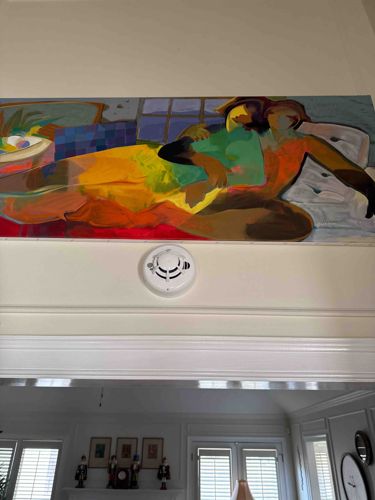
This is a large-format modern figurative painting, likely executed in oil or acrylic on canvas, depicting two reclining figures. The overall palette is vibrant and warm, dominated by yellows, greens, oranges, and deep reds, with cooler blue and purple tones in the background elements. The figures are rendered in a semi-abstract or expressionistic style, with simplified forms and a focus on color and line to convey shape and emotion rather than precise anatomical detail. One figure, seemingly female, is depicted mostly in warm orange and red tones, reclining on what appears to be a white or very pale pillow. The other figure, draped in a vivid yellow and green garment, is embraced by the first, with an arm wrapping around a green-clad torso. The background features a large window with multiple panes, showing deeper blues and purples, suggesting an evening or interior setting. To the left, a still life arrangement with fruit and greenery is visible on a small table. The brushstrokes appear visible and loose, contributing to a dynamic and somewhat flattened perspective, typical of modern art. There are no immediate visible signs of damage, extensive wear, or repairs from the provided image, but a more direct inspection would be needed to assess the true condition of the canvas and paint layers. No artist's signature or specific maker's marks are discernible. The style suggests a 20th-century or 21st-century origin, possibly mid-to-late 20th century, given its vibrant, somewhat Fauvist- or Expressionist-influenced color application and simplified forms. The scale of the painting, hung high on a wall above a doorway, indicates it's a significant decorative piece intended to command attention in a room.
AI Appraisal Report
Upon examination of the image provided, this large-scale modern figurative painting presents as a visually compelling decorative work. It is likely executed in oil or acrylic on canvas. The style is reminiscent of mid-to-late 20th-century Expressionism or Fauvism, characterized by its vibrant, non-naturalistic color palette and simplified, emotive forms. The composition, depicting two reclining figures with a still life and window view, is well-balanced and dynamic. Based on the visual evidence, the painting appears to be in good condition, with no visible craquelure, paint loss, or repairs. However, physical inspection is required to confirm the stability of the canvas and paint layers.
Critically, the artist is unknown as no signature is discernible in the image. This anonymity is the most significant factor limiting the painting's value. While the work is skillfully executed and aesthetically pleasing, without an attributable artist, it is valued primarily as a decorative piece rather than a fine art investment. The market for well-executed, decorative works of this style and scale is steady. Comparable unsigned paintings of similar size and quality typically sell in the low four-figure range at auction and in galleries. The demand is for strong visual impact over artist recognition.
To establish a higher value, full authentication is necessary. An in-person examination would allow for inspection of the reverse for gallery labels, inscriptions, or a hidden signature. Provenance research, including any sales records or exhibition history, would be crucial. Without such information, the work remains an attractive but anonymous piece, and my estimated fair market value reflects this.