These notes were written by the person who submitted this item. Appraiser.AI has not verified them, and the AI's identification and estimate may rely on them.
AI Estimated Value
Not an official valuation
$150-250
AI estimate as of October 18, 2025 · verify with a professional before acting
AI-Generated · Verify before acting
Everything on this page is generated by AI for informational purposes only. AI can make mistakes — the AI may misidentify items or misattribute them (artist, maker, brand, designer, origin, era). This is not an official valuation and should not be used for insurance, sale, tax, estate, legal, or lending purposes — or any decision requiring a certified appraisal. It is not an authoritative claim about any person, brand, or rights holder — do not share or rely on it as a factual statement about a third party. Always consult qualified professionals before making financial decisions.
This analysis also relies on unverified notes provided by the user, which may be incomplete or inaccurate and could affect the result.
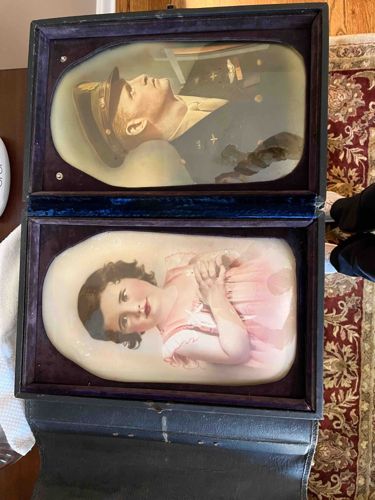
This item is a hinged, dual-chambered presentation case containing two hand-colored photographs, likely printed on opaline glass or a similar translucent medium, each set within a recessed, velvety lining. The case itself appears to be constructed of wood, covered in dark, possibly leatherette or embossed paper, with a slightly textured finish and visible wear, particularly along the edges and corners, suggesting age and handling. The interior of both compartments is lined with a dark blue or purple velvet material, which is plush and appears to securely hold the photographic plates. Each photograph is oval-shaped with an irregular, organic contour, suggesting a hand-cut or custom-designed frame for the image. The top compartment features a portrait of a man in military uniform, likely from the mid-20th century, identifiable by the style of his cap and jacket. The image shows some discoloration and what appears to be water damage or degradation, particularly in the lower right quadrant, creating mottled dark areas. The bottom compartment holds a portrait of a young girl, possibly a child, with dark curly hair and a pink dress, depicted with her hands clasped. This image also exhibits some minor discoloration or fading consistent with age, but appears to be in better condition than the male portrait. Both photographs exhibit evidence of hand-coloring, enhancing facial features, uniforms/clothing, and adding a lifelike quality. The unique curved shapes of the photographic plates and their velvet-lined presentation within a custom-made case indicate a high degree of craftsmanship and personalization, common in memorial or cherished family portraits from the late 19th to mid-20th century. The case features metal hinges and a clasp mechanism, though the clasp is not fully visible. The overall condition suggests a vintage item, with the physical characteristics of the photographs pointing towards processes like milk glass photography or hand-colored albumen prints mounted on translucent media. The item's age is estimated to be mid-20th century, likely between the 1930s-1950s, given the uniform style and photographic aesthetic.
AI Appraisal Report
This item is a fascinating example of Cased Hand-Colored Photographs on Opaline Glass, likely dating from the mid-20th century (1930s-1950s) based on the military uniform and photographic style. The hinged, dual-chambered presentation case, while showing significant wear on its exterior, retains its original dark velvet lining, which is crucial for preserving and presenting these delicate items. The use of opaline glass or a similar translucent medium for the oval, hand-cut photographs, combined with hand-coloring, suggests a custom and cherished piece, often associated with memorial or family portraits. The male portrait in military uniform shows noticeable water damage and discoloration, significantly impacting its visual quality. The female child's portrait is in better condition, though minor discoloration is present.
In terms of market conditions, items like these fall into the niche category of early photography, militaria, and sentimental ephemera. While there is a consistent demand from collectors interested in photographic processes, military history, and unique personal artifacts, the condition issues—particularly the damage to the male portrait—will limit its top-tier value. Comparables for well-preserved cased photographs on opaline glass can range higher, but the visible degradation places this item in the mid-range. The rarity lies more in the specific family history it represents rather than the photographic technique itself, which was relatively common for its time.
Without a direct physical examination, I can only assess the condition based on the provided images. A hands-on inspection would allow for a definitive identification of the translucent medium (opaline glass, milk glass, or other), a more precise assessment of the extent of the water damage and discoloration, and verification of the hand-coloring technique. Provenance documentation, if available, would significantly enhance its historical value. However, based on my visual assessment, the condition of the male portrait is the primary factor limiting a higher appraisal.