These notes were written by the person who submitted this item. Appraiser.AI has not verified them, and the AI's identification and estimate may rely on them.
AI Estimated Value
Not an official valuation
$50-150
AI estimate as of June 16, 2025 · verify with a professional before acting
AI-Generated · Verify before acting
Everything on this page is generated by AI for informational purposes only. AI can make mistakes — the AI may misidentify items or misattribute them (artist, maker, brand, designer, origin, era). This is not an official valuation and should not be used for insurance, sale, tax, estate, legal, or lending purposes — or any decision requiring a certified appraisal. It is not an authoritative claim about any person, brand, or rights holder — do not share or rely on it as a factual statement about a third party. Always consult qualified professionals before making financial decisions.
This analysis also relies on unverified notes provided by the user, which may be incomplete or inaccurate and could affect the result.
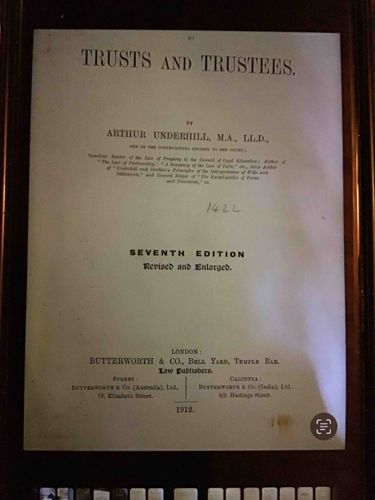
The item is a vintage legal textbook titled "Trusts and Trustees" authored by Arthur Underhill, M.A., LL.D. The title is displayed prominently in large, bold, sans-serif font at the top of the page. Below the author's name, smaller text, likely detailing his qualifications and other works, is present but partially obscured and distorted in the image. A handwritten number "1422" appears on the page, possibly an inventory or call number. The book is stated to be the "SEVENTH EDITION, Revised and Enlarged." Publication details are present at the bottom, indicating it was published in London by Butterworth & Co., Bell Yard, Temple Bar, identified as "Law Publishers." Branch locations are listed for Sydney (Butterworth & Co. (Australia), Ltd., 18, Elizabeth Street) and Calcutta (Butterworth & Co. (India), Ltd., 4/1, Hastings Street). The publication year is clearly marked as 1912. The paper appears aged with some yellowing and potential foxing visible, though the overall text remains legible. A faint, possibly water or age-related stain, is present on the lower right portion of the page. The item is framed, and the frame is partially visible at the edges of the image, suggesting it is displayed. Based on the publication date, the book is over a century old and can be considered an antique legal publication.
AI Appraisal Report
Upon examining the image provided, I am assessing this copy of "Trusts and Trustees" by Arthur Underhill, Seventh Edition, published in 1912 by Butterworth & Co. My assessment of condition is based solely on the visible portion of the title page. The paper shows signs of age, including yellowing and potential foxing. A faint stain is visible, and the overall print appears legible despite this. The owner states the book is in good condition, which I infer applies to the binding and the rest of the text, although I cannot verify this from the single image. The framing partially obscures the edges, and I cannot comment on its condition or impact on the book. Authenticity, based on the title page and publication details, appears consistent with a legal text from this era and publisher. However, definitive authenticity verification from an image is limited. A thorough in-person examination would be required to assess the binding, completeness of the text, paper quality throughout, and overall state of preservation. Provenance documentation detailing the book's history would also be valuable. Market conditions for historical legal texts are generally niche. While this is a standard treatise on trusts, the 1912 edition, though vintage, may not hold significant collectible value unless it belonged to a notable legal figure or had unique annotations. Comparables for similar standard legal textbooks of this age and condition typically range in value. Demand is primarily from legal historians, institutions, or individuals with a specific interest in the history of trust law. Rarity is moderate; while not a mass-market book, it was a published legal text of its time. Factors impacting value significantly include the actual condition of the entire book (which I cannot fully assess), any unique provenance, and market demand within the specific legal history collecting area.