AI Appraisal Estimate

AI-generated estimates · not official valuations

From the user

What was submitted

Photo and notes provided by the user — not generated by AI

Submitted item photo
Submitted photo · May 19, 2026

User's notes

No additional notes provided.

AI analysis below

AI appraisal

AI analysis & estimate

AI-Generated · Verify before acting

Everything below is generated by AI for informational purposes only. AI can make mistakes — the AI may misidentify items or misattribute them (artist, maker, brand, designer, origin, era). This is not an official valuation and should not be used for insurance, sale, tax, estate, legal, or lending purposes — or any decision requiring a certified appraisal. It is not an authoritative claim about any person, brand, or rights holder — do not share or rely on it as a factual statement about a third party. Always consult qualified professionals before making financial decisions.

Read the full disclaimer

AI Identification

·Not independently authenticated·Verify before acting

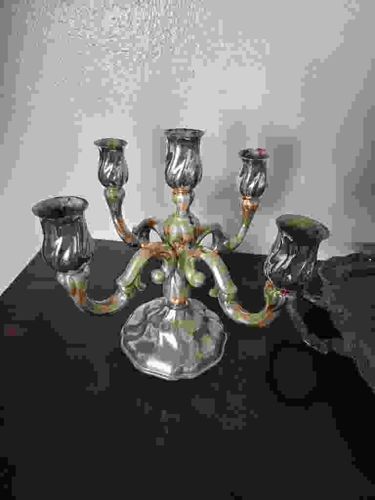
Five-Light Silver-Plated Rococo Style Candelabrum

Home Decor / Antiques

AI Estimated Value

·Not an official valuation·Verify before acting

$150 - $250

As of May 19, 2026

AI Item Analysis

·AI can make mistakes·Verify before acting
This is a five-light candelabrum featuring a central candle holder flanked by four sweeping scrolled arms. The piece is constructed from metal, likely a silver-plated base metal, and displays a prominent Rococo-influenced aesthetic with its fluid, organic curves and leaf-like scrollwork on the arms and central column. The candle cups themselves exhibit a twisted, fluted vertical ribbing that suggests a tulip-like form. The base is weighted and shaped with a multi-lobed, scalloped edge to provide stability for the wide span of the arms. Physically, the item shows significant signs of age and patina; there is a visible loss of silver plating, revealing a yellowish-green or brassy oxidation underneath commonly seen in copper-alloy bases. This tarnish and 'bleeding' of the underlying metal suggest a late 19th to early 20th-century manufacture. The condition is fair, with uneven distribution of the remaining silver finish and possible residue from previous wax use in the depressions. There are no visible maker's marks from this angle, but the quality of the casting and the complex, interlocking arm structure indicate a mid-level production piece intended for formal dining decor. The overall silhouette is ornate, typical of Victorian revival styles designed to mimic 18th-century French extravagance.
AI Appraisal Report

·AI can make mistakes·Verify before acting
Based on my visual examination of this five-light silver-plated candelabrum, I have identified it as a late 19th to early 20th-century piece in the Rococo Revival style. The item features classic scrolled arms and tulip-shaped sockets. However, the condition is a primary factor in this valuation; I observed significant 'bleeding,' where the silver plating has worn away to reveal the copper-alloy base metal (likely nickel silver or brass). This loss of plate, combined with visible oxidation and wax residue, places the item in 'fair' condition. Market demand for large Victorian-era silver-plated service pieces has softened in recent years as contemporary tastes shift toward more minimalist decor. While the ornate silhouette is historically charming, silver-plate does not hold the intrinsic metal value of sterling silver. Comparable pieces in similar condition typically sell at estate auctions or antique malls within the $150 to $250 range. If the item bore a prestigious maker's mark (such as Elkington & Co or Christofle), the value could increase, but no such mark is visible. Limitations: This appraisal is based strictly on photographic evidence. A physical inspection is necessary to check for 'weighted' bases (often filled with cement or pitch), which affects structural integrity but not necessarily value. I would also need to examine the underside for hallmarks to definitively rule out a sterling manufacture or identify a specific foundry. Without provenance documentation or a physical acid test, the base metal composition and exact date of manufacture remain an professional estimation based on visual wear patterns.

Get your items appraised

Instant estimates of your treasures with AI-powered appraisals

Browse More Appraisals