These notes were written by the person who submitted this item. Appraiser.AI has not verified them, and the AI's identification and estimate may rely on them.
AI Estimated Value
Not an official valuation
$900 - $1,500
AI estimate as of August 26, 2025 · verify with a professional before acting
AI-Generated · Verify before acting
Everything on this page is generated by AI for informational purposes only. AI can make mistakes — the AI may misidentify items or misattribute them (artist, maker, brand, designer, origin, era). This is not an official valuation and should not be used for insurance, sale, tax, estate, legal, or lending purposes — or any decision requiring a certified appraisal. It is not an authoritative claim about any person, brand, or rights holder — do not share or rely on it as a factual statement about a third party. Always consult qualified professionals before making financial decisions.
This analysis also relies on unverified notes provided by the user, which may be incomplete or inaccurate and could affect the result.
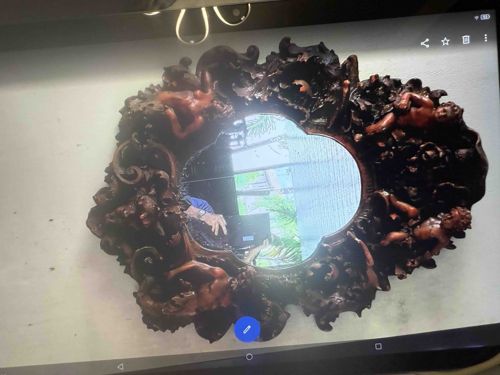
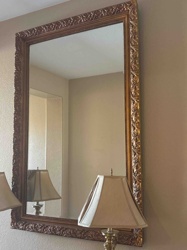
This is an antique or vintage wall mirror, characterized by a highly ornate, free-form wooden frame. The frame appears to be carved from a dark, possibly stained or naturally rich dark wood, exhibiting a gnarled, root-like, or possibly 'burl' aesthetic, emphasizing its organic and sculptural qualities. Integrated into the frame's design are multiple figures, specifically putti or cherubs, carved in relief. These figures are rendered in a lighter wood tone, possibly a different type of wood or a contrasting finish, creating visual depth and highlighting their forms against the darker frame. One cherub is distinctly visible towards the top right, another near the bottom right, and a third towards the top left, amidst swirling, cloud-like or foliage-inspired carvings. The mirror itself is centrally placed, with an irregularly shaped, possibly scalloped or cloud-like edge, rather than a standard circular or oval shape, complementing the organic nature of the frame. The mirror surface shows reflections, indicating it is intact with no visible major cracks or shattered areas in the image. The overall condition appears consistent with an antique item, likely exhibiting natural patina, minor surface wear, and potential darkening of the wood over time. There are no visible manufacturer's marks or signatures in the provided image. The elaborate carving work, particularly the detailed putti, suggests a high level of craftsmanship and could point to a Baroque, Rococo, or Victorian revival style, likely from the late 19th to early 20th century.
AI Appraisal Report
Upon visual examination of the Ornate Carved Wood Wall Mirror, I have assessed its characteristics to determine a fair market value. The piece presents as a high-quality, likely late 19th or early 20th-century decorative mirror, executed in a Victorian revival style that heavily borrows from Rococo and Black Forest aesthetics. The frame's dark, gnarled wood carving, contrasted with the lighter-toned, well-rendered putti figures, demonstrates significant craftsmanship and artistic ambition. The condition, based on the provided image, appears to be very good for its age, with the glass intact and the carvings seemingly free from major damage, although minor surface wear and patina are expected.
The market for such ornate, decorative mirrors is relatively stable, with consistent demand from interior designers and collectors of Victorian-era furniture. Comparable pieces of similar size, complexity, and condition typically sell in a range reflecting their decorative appeal. The primary value driver here is the quality of the carving and the overall dramatic visual impact. The free-form, asymmetrical design adds to its rarity and appeal.
However, it is crucial to note the limitations of an appraisal based solely on images. Without a physical inspection, I cannot confirm the specific type of wood, the exact age, or verify if the piece has undergone any repairs or restorations which could impact value. Full authentication would require in-person examination to look for maker's marks, analyze tool marks and construction techniques, and potentially test the wood species. Documentation of provenance would also significantly enhance its value.