AI estimate as of August 28, 2025 · verify with a professional before acting
AI-Generated · Verify before acting
Everything on this page is generated by AI for informational purposes only. AI can make mistakes — the AI may misidentify items or misattribute them (artist, maker, brand, designer, origin, era). This is not an official valuation and should not be used for insurance, sale, tax, estate, legal, or lending purposes — or any decision requiring a certified appraisal. It is not an authoritative claim about any person, brand, or rights holder — do not share or rely on it as a factual statement about a third party. Always consult qualified professionals before making financial decisions.
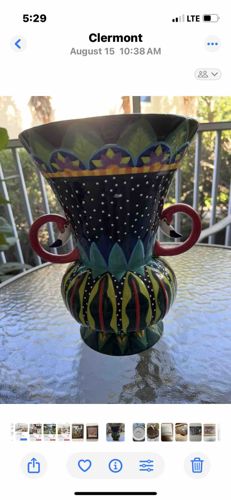
This appears to be a highly decorative, hand-painted ceramic or glazed terracotta vase, characterized by its vibrant colors and eclectic design. The vase features a multifaceted profile, starting with a flared rim at the top, transitioning into a narrower neck, a globular central body, and resting on a footed base. The dominant colors used in the painted decoration include deep blues, greens, yellows, reds, and pops of purple and white.
Starting from the top, the interior rim is a dark blue, while the exterior features a band of teal-green, scallop-shaped motifs with white outlines, topped by a yellow and purple patterned border. The main body of the neck is a dark blue or black, heavily adorned with white polka dots. A very distinctive feature are the two handles, colored in red and shaped in a circular fashion, with what appear to be small, black, stylized bird (possibly flamingo or crane) heads integrated where they attach to the vase body. The mid-section directly below the handles has raised, leaf-like or petal-like structures, painted in a light green. Below this, the globular body is decorated with elongated, wavy stripes in yellow and green, interspersed with vertical red lines, and small white dots. The base of the vase is a solid deep green.
Craftsmanship appears to be detailed given the intricate hand-painted patterns and the sculptural elements like the handles and raised motifs. The surface appears glossy, indicative of a glazed finish. There are no clear visible condition issues such as chips, cracks, or significant paint loss from the provided image, suggesting it is in good, used condition. No specific maker's marks or signatures are discernible from the image. Based on the whimsical and colorful aesthetic, it likely dates to the late 20th century or early 21st century, possibly drawing inspiration from folk art or contemporary art movements.
AI Appraisal Report
Upon visual examination of the provided images, this Hand-Painted Whimsical Ceramic Vase with Bird-Head Handles appears to be in good, used condition. I observe no obvious chips, cracks, or significant paint loss, and the glossy finish suggests the glaze is intact. Authenticity, based solely on visual evidence, points to a genuine, hand-crafted piece, likely late 20th to early 21st century given its whimsical aesthetic and vibrant palette. However, without a physical inspection, specific maker's marks, signatures, or methods of construction (e.g., slip-cast vs. hand-built ceramic) cannot be confirmed.
In terms of market conditions, decorative ceramic vases, particularly those with unique, artistic flair like this one, generally perform well in the secondary market. Comparables for hand-painted, contemporary folk art-inspired ceramics by unknown artists typically range from modest to moderate values. The 'bird-head' handles and intricate, colorful motifs elevate its appeal beyond mass-produced items, indicating a higher level of craftsmanship. While not exceptionally rare, its distinctive design contributes to its desirability among collectors seeking unique decorative arts.
Factors impacting value include its good condition, detailed hand-painting, and unique sculptural elements. The absence of a known artist or prominent provenance limits its upper valuation, as does the inherent subjectivity of 'whimsical' art. Demand exists for unique, well-executed decorative pieces, but they rarely reach high values unless attributed to a significant artisan.
For full authentication, an in-person examination would be crucial to assess the material's exact composition (ceramic vs. terracotta), internal construction, and to search for any faint marks or inscriptions not visible in photographs. Provenance documentation, if available, linking it to a specific artist or gallery, would significantly enhance its value and confirm its origins. Scientific testing, such as thermoluminescence dating, would be an extreme measure and typically not warranted for an item of this estimated age and value.