AI estimate as of June 29, 2025 · verify with a professional before acting
AI-Generated · Verify before acting
Everything on this page is generated by AI for informational purposes only. AI can make mistakes — the AI may misidentify items or misattribute them (artist, maker, brand, designer, origin, era). This is not an official valuation and should not be used for insurance, sale, tax, estate, legal, or lending purposes — or any decision requiring a certified appraisal. It is not an authoritative claim about any person, brand, or rights holder — do not share or rely on it as a factual statement about a third party. Always consult qualified professionals before making financial decisions.
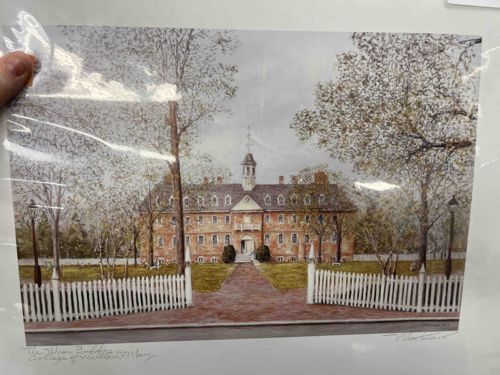
This item is a historical architectural art print depicting "The Wren Building" at the College of William & Mary. The print is rectangular, rendered in a representational style with a palette dominated by earthy tones, muted greens, grays, and whites, suggesting a watercolor or pastel medium for the original artwork. The central focus is the iconic Wren Building, characterized by its red brick facade, numerous symmetrically placed windows, traditional dormer windows on the roof, and a distinctive cupola topped with a weather vane. A central portico leads to the main entrance. In the foreground, a brick path extends from the viewer towards the building, flanked on either side by manicured grassy areas. A classic white picket fence with open gates frames the path, separating the foreground from the building. Several bare or sparsely leafed deciduous trees, indicative of late winter or early spring, are positioned throughout the composition, providing depth and framing the building. The sky above is overcast, contributing to the print's subdued atmosphere.
The print appears to be on standard art paper or cardstock. Its exact dimensions are not discernible from the image, but it appears to be a common print size. The overall condition of the print itself is difficult to ascertain precisely due to it being protected within a clear, somewhat wrinkled plastic sleeve, which is causing glare across its surface. However, no overt damage such as tears, significant creases, or heavy staining is visible through the protective layer. Manufacturing details are clearly visible at the bottom. On the lower left, "The Wren Building, College of William & Mary" is printed, identifying the subject precisely. On the lower right, a signature, likely "Robert Graham '79", indicates the artist and possibly the year of creation or publication of the print. This suggests it is a signed art print, likely produced around 1979, making it a vintage collegiate commemorative piece. The precise rendering of architectural details and the nuanced color work indicate good quality craftsmanship in the reproduction.
AI Appraisal Report
As an appraiser, I have examined the provided image of "The Wren Building, College of William & Mary Art Print."
Condition & Authenticity: The print appears to be in good overall condition, though its precise state is obscured by a wrinkled plastic sleeve. No overt tears or significant creases are visible through the protective layer. The identification text and signature ("Robert Graham '79") are clear. Authenticity hinges on whether "signed" indicates an original hand-signature by Robert Graham or a printed reproduction of his signature. As an "art print," it is likely a reproduction of an original artwork, rather than an original etching or lithograph.
Market & Comparables: This item falls into the category of vintage collegiate commemorative art. Its primary market is alumni, students, and enthusiasts of the College of William & Mary. Comparable items include other vintage university-themed prints by local or regional artists. These generally trade in the decorative art market, not the fine art investment market.
Demand & Rarity: Demand is niche-specific, primarily from individuals with an affinity for the college. Given its nature as a print of an iconic building, it is unlikely to be rare, suggesting a larger production run. Rarity would increase significantly only if it were a very limited edition, an artist's proof, or an original work which is not indicated.
Value Impact Factors: The most critical factor is whether the signature is original ink or printed. An original hand-signature would slightly enhance value. The actual condition upon removal from the sleeve (creases, foxing, fading) and the artist's broader recognition also influence value.
Limitations: A definitive assessment of condition requires physical examination once removed from the sleeve. Full authentication of the signature as an original hand-signature versus an autopen or printed signature necessitates in-person inspection under magnification, comparison with verified exemplars, and potentially provenance documentation. Without this, the appraisal assumes it is a standard commemorative print.