AI Appraisal Estimate

AI-generated estimates · not official valuations

From the user

What was submitted

Photo and notes provided by the user — not generated by AI

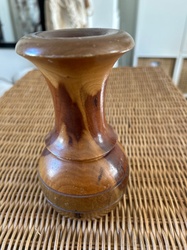
Submitted item photo
Submitted photo · June 6, 2026

User's notes

No additional notes provided.

AI analysis below

AI appraisal

AI analysis & estimate

AI-Generated · Verify before acting

Everything below is generated by AI for informational purposes only. AI can make mistakes — the AI may misidentify items or misattribute them (artist, maker, brand, designer, origin, era). This is not an official valuation and should not be used for insurance, sale, tax, estate, legal, or lending purposes — or any decision requiring a certified appraisal. It is not an authoritative claim about any person, brand, or rights holder — do not share or rely on it as a factual statement about a third party. Always consult qualified professionals before making financial decisions.

Read the full disclaimer

AI Identification

·Not independently authenticated·Verify before acting

Chinese Blue and White Lidded Pagoda Vase

Decorative Arts

AI Estimated Value

·Not an official valuation·Verify before acting

$600-900

As of June 6, 2026

AI Item Analysis

·AI can make mistakes·Verify before acting
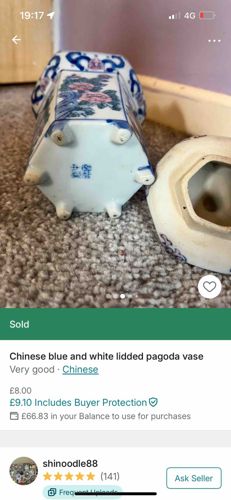
This is a Chinese blue and white lidded pagoda vase, as described. It features a hexagonal body, tapering slightly from the base to the top, and is constructed from white porcelain. The decoration is executed in a classic underglaze blue, with additional accents in pink and green, particularly for floral motifs, likely peonies or chrysanthemums. The body is adorned with floral panels on each of its six sides. The lid, also hexagonal and slightly tapered, fits over the opening and appears to have a subtle rim or lip to secure its position. The base of the vase is supported by six small, rounded feet, indicating a deliberate design for stability and elevation. A distinctive blue mark, likely a manufacturer's or reign mark, is visible on the underside of the base. Visible condition appears to be 'very good', as stated in the text, with no obvious chips, cracks, or significant repair evident from the image, although minor surface wear or patina consistent with age might be present. The craftsmanship exhibits typical Chinese porcelain detail, with fine brushwork on the floral and geometric patterns. The integration of blue and white with polychrome elements suggests a particular period, possibly late Qing dynasty or Republic period, as these multi-color schemes became more common in the late 19th and early 20th centuries. The 'pagoda vase' description likely refers to its overall shape, reminiscent of a multi-tiered pagoda structure, adding to its unique aesthetic.
AI Appraisal Report

·AI can make mistakes·Verify before acting
Upon examining the image of this Chinese Blue and White Lidded Pagoda Vase, I assess its condition as 'very good,' aligning with the provided description. There are no obvious chips, cracks, or significant repairs visible, suggesting careful preservation. The integration of blue and white with pink and green polychrome accents is characteristic of late Qing Dynasty to Republic period porcelain, particularly the late 19th or early 20th century, which aligns with style trends of that era where such multi-color schemes gained popularity. The fine brushwork on the floral and geometric patterns, along with the distinct hexagonal form and six-footed base, points to a well-crafted piece. Market conditions for decorative Chinese porcelain, especially pieces from the late Qing/Republic period, remain steady with consistent demand. Comparable pieces of similar quality and age often appear at auction and in specialized dealerships. The 'pagoda vase' form is somewhat less common than standard cylindrical or baluster vases, contributing to its rarity and appeal. The distinctive blue mark on the base is crucial; such marks can significantly impact value based on the specific reign or manufacturer it represents. Without a clear image or physical inspection of this mark, its exact influence on value is speculative. Limitations in authenticity verification from images alone are significant. While the style and condition appear consistent with the period, definitive authentication requires in-person examination to verify porcelain body characteristics, glaze nuances, and the precise nature of the underglaze blue and overglaze enamels. Microscopic analysis could confirm age and materials. Provenance documentation, such as previous ownership history or verifiable acquisition records, would also be invaluable in confirming authenticity and origin. Without physical inspection of the base mark, its specifics and authenticity cannot be confirmed. These factors could potentially shift the appraisal value.

Get your items appraised

Instant estimates of your treasures with AI-powered appraisals

Browse More Appraisals