AI estimate as of August 15, 2025 · verify with a professional before acting
AI-Generated · Verify before acting
Everything on this page is generated by AI for informational purposes only. AI can make mistakes — the AI may misidentify items or misattribute them (artist, maker, brand, designer, origin, era). This is not an official valuation and should not be used for insurance, sale, tax, estate, legal, or lending purposes — or any decision requiring a certified appraisal. It is not an authoritative claim about any person, brand, or rights holder — do not share or rely on it as a factual statement about a third party. Always consult qualified professionals before making financial decisions.
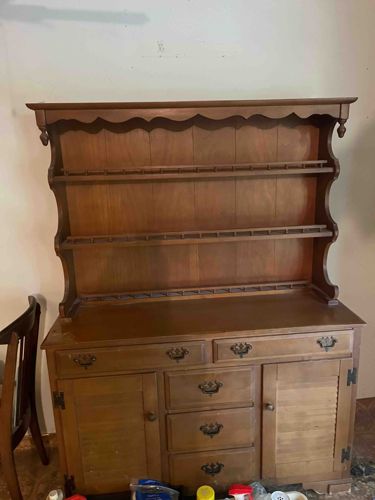
This is a wooden hutch, likely constructed from a solid wood such as oak or possibly a fruitwood, given its warm, medium-brown tone with visible grain. The hutch is composed of two main parts: a buffet base and a detached hutch top. The hutch top features a graceful scalloped cornice at the very top, adding a decorative touch. Below this, there are three open shelves, each equipped with a prominent grooved plate rail designed to hold decorative plates upright. The side supports of the hutch top are scrolled or curved, contributing to a somewhat traditional or country aesthetic. The buffet base consists of a flat top surface, directly beneath which are three drawers. The central drawer appears to be wider than the two flanking ones. Below these, there is a central section with three stacked drawers, flanked by two cabinet doors, one on each side. The cabinet door on the left appears to be a solid panel, while the one on the right features a louvered or slatted design, which is a distinguishing characteristic. All visible drawers and cabinet doors are fitted with dark-toned, possibly cast iron or antiqued brass, bail pull hardware, featuring decorative escutcheon plates. The overall construction appears sturdy, and the piece exhibits a consistent finish. There are no obvious signs of significant damage like large cracks or breaks, but typical wear commensurate with age, such as minor scratches, scuffs, or a slight dulling of the finish, might be present upon closer inspection. The style suggests it could be from the mid to late 20th century, possibly reflecting a colonial revival or farmhouse style. The craftsmanship seems standard for mass-produced furniture of its era, prioritizing functionality and a homey aesthetic.
AI Appraisal Report
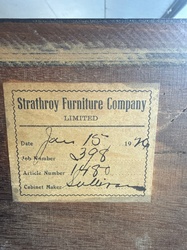
Upon visual examination of the provided image, I assess this wooden buffet hutch with plate rails to be in good, used condition. While I cannot discern minor wear, such as scratches or scuffs, without an in-person inspection, the overall structure appears sound with no visible significant damage. The design elements, including the scalloped cornice, plate rails, bail pull hardware with escutcheon plates, and particularly the distinct louvered cabinet door on the right, strongly suggest a mid to late 20th-century American manufacture, likely in a Colonial Revival or Country style. Authenticity, based solely on imagery, is limited to visual characteristics; I cannot verify the specific wood type (oak or fruitwood) or construction methods without physical examination. Provenance documentation would be essential for tracing its history and confirming any specific manufacturer or artisan claims, if applicable. From a market perspective, pieces like this are common. While functional and aesthetically pleasing, they are not rare. The demand for such traditional, somewhat bulky furniture has softened in recent years compared to mid-century modern or more contemporary styles. However, its utility and the charming farmhouse aesthetic maintain a consistent, albeit modest, interest. Factors impacting value include its good condition, functionality as a storage and display unit, and the consistent traditional styling. The mass-produced nature of such pieces from that era means they rarely command high prices unless associated with a particularly renowned maker, which is not evident here. Without physical inspection, I cannot confirm joinery, internal condition, or the quality of the finish beyond what is visible in the image. Scientific testing of the wood or finish would be needed for definitive dating or material identification beyond visual assessment.