AI estimate as of June 20, 2025 · verify with a professional before acting
AI-Generated · Verify before acting
Everything on this page is generated by AI for informational purposes only. AI can make mistakes — the AI may misidentify items or misattribute them (artist, maker, brand, designer, origin, era). This is not an official valuation and should not be used for insurance, sale, tax, estate, legal, or lending purposes — or any decision requiring a certified appraisal. It is not an authoritative claim about any person, brand, or rights holder — do not share or rely on it as a factual statement about a third party. Always consult qualified professionals before making financial decisions.
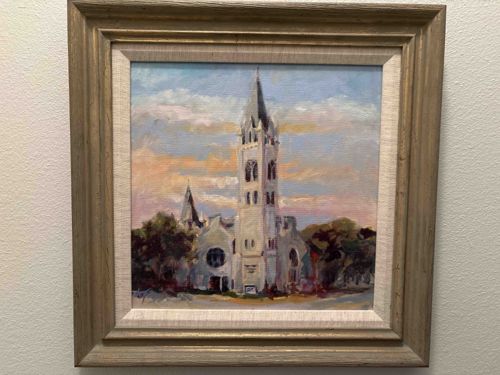
This item is an oil painting depicting a church with a prominent steeple, set against a sky showing hues of blue, pink, and orange, suggesting either dawn or dusk. The painting is executed with visible brushstrokes, indicating a textured surface quality typical of impasto techniques, particularly noticeable in the rendering of the clouds and architectural elements. The church itself appears to be of sturdy stone construction, with multiple arched windows and a tall, slender spire. Another, smaller steeple is visible in the background to the left. Lush green trees frame the building on both sides, suggesting a natural or urban park-like setting. The overall color palette is muted but rich, with soft pastels for the sky contrasting with the off-white and gray tones of the church. The painting is housed within a wooden frame that appears to be made of light-colored, possibly distressed or naturally finished wood, with a slightly textured or grained surface. The frame has a simple, classic profile with a raised inner edge and a deeper outer edge, providing a subtle relief. A signature is visible in the lower left corner of the painting, though it is not clearly discernible from the image. The painting appears to be in good condition, showing no obvious signs of damage, cracks, or significant wear. The style suggests a 20th-century landscape or architectural painting, possibly dating from the mid-to-late 20th century, leaning towards a traditional or impressionistic approach. The craftsmanship appears to be of a reasonable quality, with attention to light and shadow.
AI Appraisal Report
I have examined the provided image of this Church Landscape Oil Painting. Based on this visual assessment, the condition of the painting appears to be good; I observe no obvious damage, cracks, or significant wear. The brushwork suggests a textured, possibly impasto, surface, consistent with the described style. Authenticity, however, is severely limited by image-only review. While a signature is visible, I cannot discern it, making attribution impossible purely from the image. For full authentication, in-person examination is critical to assess pigment, canvas, and brushstroke integrity, and to properly identify the signature. Provenance documentation is essential for establishing history of ownership and exhibition. Scientific testing, such as pigment analysis or dendrochronology for the stretcher, would be necessary for definitive dating and material authentication.
In terms of market conditions, paintings in a traditional or impressionistic style, particularly landscapes with architectural elements like this, generally maintain consistent demand. However, the exact value is heavily dependent on the artist's recognition, the painting's historical significance, and overall artistic quality. Without a discernible artist, it falls into the category of decorative art. Comparables would include other unsigned or lesser-known artist oil landscapes of similar size and complexity from the mid-to-late 20th century. Demand for such pieces is moderate, driven primarily by aesthetic appeal rather than rarity, unless the artist is eventually identified as significant. Factors significantly impacting value here are the lack of artist identification and provenance. If a known artist's signature were clearly visible and verified, the value could increase substantially. Conversely, if it is determined to be a student work or reproduction, the value would decrease.
Therefore, my appraisal assumes this is an original, unsigned or undeciphered, decorative oil painting from the mid-to-late 20th century. The quality of execution appears reasonable, with attention to light and shadow, but it lacks the unique distinction or verifiable attribution that would command a higher price. This appraisal is strictly based on the visual information provided and is provisional without further authentication.