AI estimate as of July 18, 2025 · verify with a professional before acting
AI-Generated · Verify before acting
Everything on this page is generated by AI for informational purposes only. AI can make mistakes — the AI may misidentify items or misattribute them (artist, maker, brand, designer, origin, era). This is not an official valuation and should not be used for insurance, sale, tax, estate, legal, or lending purposes — or any decision requiring a certified appraisal. It is not an authoritative claim about any person, brand, or rights holder — do not share or rely on it as a factual statement about a third party. Always consult qualified professionals before making financial decisions.
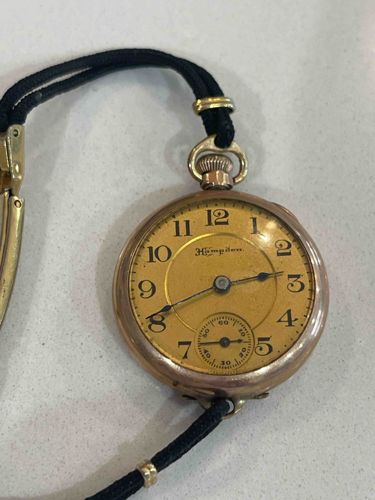
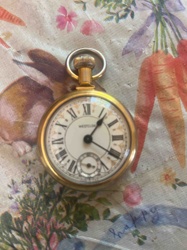
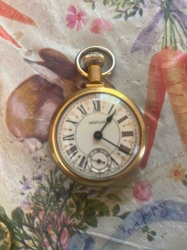
This item is an antique or vintage ladies' pendant watch, likely intended to be worn on a necklace or as a chatelaine. The watch features a circular, gold-toned metal case, possibly gold-filled or brass, exhibiting some wear and minor discoloration consistent with age, particularly around the bezel and bail. The dial is a warm, matte gold or champagne color, displaying black Arabic numerals for hours 1 through 12. The hands appear to be blued steel, in a
ye-shaped or spade-style, with a central pivot that shows some slight oxidation or dirt. A prominent sub-dial for seconds is located at the 6 o'clock position, marked with 10-second intervals and minor tick marks. The manufacturer's name, 'Hampden.', is clearly visible on the upper half of the dial in an elegant, cursive script. The watch is suspended by a black cord or ribbon, possibly silk or a similar material, with small gold-toned beads or sliders; one bead is visible near the bottom lug and two at the top where the cord forms a loop. The winding crown and bail are gold-toned and show signs of use. The overall condition suggests a well-loved piece, with an evident patina and minor surface scratches on the case. There are no visible chips or cracks in the crystal, though its clarity might be slightly reduced by age. The construction appears to be machine-made, indicating a period of mass production, likely from the early 20th century, possibly 1900s-1930s, given the dial style and the Hampden brand's active period. The craftsmanship, while not excessively ornate, indicates a functional and aesthetically pleasing design typical of its era.
AI Appraisal Report
Upon visual examination of this Hampden Ladies' Pendant Watch, I assess its condition as good, consistent with its likely age from the early 20th century (1900s-1930s). The gold-toned case shows expected wear and minor discoloration, indicative of a well-loved piece rather than significant damage. The dial, with its matte gold/champagne tone and black Arabic numerals, appears complete with "Hampden." clearly legible. The blued steel hands, while showing slight oxidation, are intact. The sub-seconds dial at 6 o'clock is a characteristic feature of watches from this period. There are no visible chips or cracks to the crystal, which is a positive. The black cord and gold-toned beads are likely period-appropriate replacements or original, complementing the piece.
Authenticity, based solely on imagery, appears high for a Hampden-branded watch of this style. Hampden was a prolific American watch manufacturer known for mass-produced yet quality timepieces. The dial script and overall design align with known Hampden aesthetics.
In terms of market conditions, demand for vintage ladies' pendant watches is generally moderate, with specific interest for brands like Hampden. Rarity is not exceptionally high given Hampden's production volumes, but good condition examples with legible dials are always more desirable. Factors impacting value include the non-precious metal case (likely gold-filled or brass, not solid gold), typical wear consistent with age, and the operational status (which cannot be determined visually).
For full authentication and a more precise valuation, an in-person examination is crucial. This would allow for inspection of the movement (serial numbers, jewel count), confirmation of case material through testing, and assessment of running condition and timekeeping accuracy. Provenance documentation, such as original sales receipts, would also add significant value and verify the item's history. Without physical access, I must note the limitations in definitively confirming internal authenticity and functionality.