AI estimate as of July 5, 2025 · verify with a professional before acting
AI-Generated · Verify before acting
Everything on this page is generated by AI for informational purposes only. AI can make mistakes — the AI may misidentify items or misattribute them (artist, maker, brand, designer, origin, era). This is not an official valuation and should not be used for insurance, sale, tax, estate, legal, or lending purposes — or any decision requiring a certified appraisal. It is not an authoritative claim about any person, brand, or rights holder — do not share or rely on it as a factual statement about a third party. Always consult qualified professionals before making financial decisions.
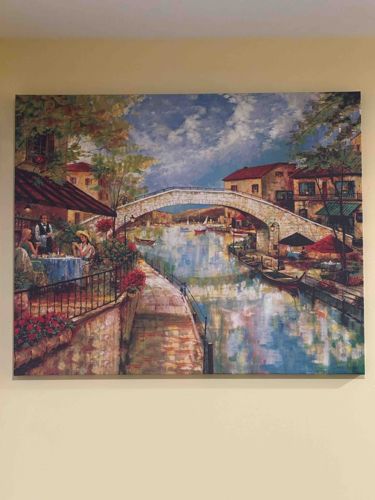
The item is a large-format, rectangular canvas print depicting a vibrant, idealized European canal scene, likely set in Italy or a similar Mediterranean locale. The artwork appears to be a reproduction of a painting, characterized by visible brushstroke textures that give it the illusion of being an original oil or acrylic painting, though its uniform surface and likely production method suggest it is a giclée or similar canvas print. The dominant colors include deep blues for the sky and water, warm oranges and browns for the buildings and path, and various greens for foliage, punctuated by bright reds from flowers.
The composition features a prominent stone arch bridge spanning a reflective canal. On the left side, there's an outdoor cafe or restaurant with figures seated at a table and a waiter attending to them, adorned with red potted flowers along a black railing. The path alongside the canal on the left has a textured, stone-like appearance. On both sides of the canal, there are multi-story buildings with characteristic European architecture, including red-tiled roofs and multiple windows. Boats are visible in the canal, both near the bridge and further down, suggesting a lively waterway. The sky above is a mix of deep blue and dynamic white clouds, reflecting in the water below.
The impression is one of a mass-produced decorative art piece, rather than a unique, hand-painted original. It shows no visible signs of damage, wear, or repair in the provided image; the colors are bright and uncensored, indicating good condition or recent manufacture. No artist's signature, maker's marks, or specific dates are discernible from the image. The style leans towards romanticized realism with impressionistic elements in its application of color and light, often found in contemporary home decor settings. Its size, though not precisely measurable, seems substantial, suitable for a prominent wall display.
AI Appraisal Report
Upon my virtual examination of this canvas print, I assess its condition as excellent. The colors are vibrant and saturated, with no visible fading, smudges, or abrasions. There are no tears, punctures, or signs of frame damage. The canvas appears taut with no sagging or warping. Authenticity, however, is a key consideration. Based on the visual evidence, which includes the uniformity of the 'brushstrokes' and the overall crispness typical of a digital reproduction, I confidently conclude this is a giclée or similar canvas print, designed to mimic an original oil painting rather than being one itself. This significantly impacts its value, as such prints are mass-produced.
In terms of market conditions, decorative canvas prints of romantic European scenes are widely available from numerous retailers, ranging from home decor stores to online marketplaces. Comparable items, often sold in large formats, typically retail new for $80 to $250. There is no inherent rarity; these pieces are produced to meet broad consumer demand for aesthetically pleasing wall art. Key value-impacting factors include its status as a print, the absence of an identifiable artist or provenance, and its decorative rather than fine art classification. Its large size is a positive, making it suitable for prominent display, but it doesn't elevate its inherent artistic value.
It is crucial to note that this appraisal is based solely on the provided image. While I am highly confident in my assessment that this is a print, a definitive confirmation of its authenticity (i.e., whether it's truly a print or an extremely well-executed original) would require a physical in-person examination. This would involve inspecting the texture of the paint, the edges of the canvas, the back of the piece for production marks or signatures not visible in the image, and potentially microscopic analysis of the pigments and canvas fiber. Provenance documentation, if any existed, would also be invaluable, though highly unlikely for a decorative print.