AI estimate as of September 29, 2025 · verify with a professional before acting
AI-Generated · Verify before acting
Everything on this page is generated by AI for informational purposes only. AI can make mistakes — the AI may misidentify items or misattribute them (artist, maker, brand, designer, origin, era). This is not an official valuation and should not be used for insurance, sale, tax, estate, legal, or lending purposes — or any decision requiring a certified appraisal. It is not an authoritative claim about any person, brand, or rights holder — do not share or rely on it as a factual statement about a third party. Always consult qualified professionals before making financial decisions.
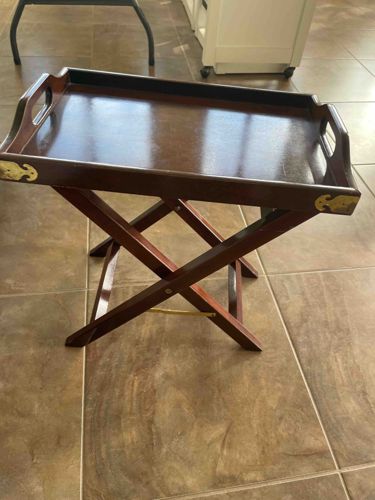
This is a vintage-style folding butler tray table, likely constructed from a hardwood such as mahogany or a similar dark-stained wood, giving it a rich, warm brown finish. The table consists of two main components: a rectangular tray with raised edges and integrated handles, and a collapsible X-frame base. The tray features a smooth, glossy surface, indicating a polished or lacquered finish, which reflects the surrounding light. The edges of the tray are slightly beveled, adding a subtle decorative touch. Integrated into the short sides of the tray are cut-out handles, allowing for easy portability when used independently. A striking feature of this piece is the brass hardware accenting the corners of the tray, where the long sides meet the short sides. These brass pieces appear to be decorative corner brackets, possibly with an ornamental motif, although the detail is somewhat obscured in the image. The folding base is designed with an 'X' shape, providing stability when open and allowing the table to be stored compactly when folded. A small, thin metal rod, possibly brass or a brass-plated material, is visible connecting the two vertical elements of the X-frame near the bottom, likely serving as a brace or hinge mechanism. The overall condition appears to be good with a visible gloss, suggesting regular care, though minor surface wear consistent with age and use may be present upon closer inspection. The style suggests a mid-20th century influence, leaning towards traditional or colonial aesthetics often found in butler trays. The craftsmanship appears solid and functional, characteristic of furniture designed for both utility and decorative appeal.
AI Appraisal Report
I have examined the provided image of this vintage-style folding butler tray table. The item appears to be constructed from a hardwood, possibly mahogany or a similar dark-stained wood, exhibiting a rich, warm brown finish. The condition, based on visual assessment, seems good, with a noticeable gloss suggesting regular maintenance. Minor surface wear consistent with age and use would likely be detectable upon closer physical inspection. The design, featuring a rectangular tray with raised edges, integrated handles, and an X-frame collapsible base, aligns with traditional or colonial aesthetics, pointing to a mid-20th-century influence.
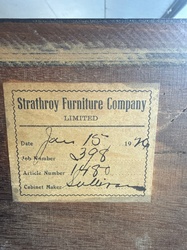
The brass hardware accents on the tray corners add a decorative touch and appear intact. The folding mechanism of the X-frame base, including the thin metal rod, seems functional, allowing for compact storage. Authenticity, based solely on this image, leans towards a genuine vintage piece rather than a modern reproduction, given the apparent quality of materials and construction. However, a full authentication would require in-person examination to assess wood grain, joinery techniques, and the patina of the brass hardware, as well as any manufacturer marks or labels.
In terms of market conditions, folding butler tray tables are moderately sought-after for their versatility and classic appeal. Comparable items in good vintage condition typically sell in the range of $100-$300, depending on the wood species, craftsmanship, and overall preservation. This piece falls within the higher end of that range due to its apparent quality and finish. Demand is consistent for functional decorative furniture, though rarity is not a significant factor here; these tables were produced in quantity. The primary factors impacting value are the material quality, the intactness of the finish, and the functionality of the folding mechanism. Without physical inspection, I cannot confirm the wood species definitively or detect subtle flaws like veneer lifting or joint instability, which could affect the final valuation.