These notes were written by the person who submitted this item. Appraiser.AI has not verified them, and the AI's identification and estimate may rely on them.
AI Estimated Value
Not an official valuation
$150-200
AI estimate as of July 5, 2025 · verify with a professional before acting
AI-Generated · Verify before acting
Everything on this page is generated by AI for informational purposes only. AI can make mistakes — the AI may misidentify items or misattribute them (artist, maker, brand, designer, origin, era). This is not an official valuation and should not be used for insurance, sale, tax, estate, legal, or lending purposes — or any decision requiring a certified appraisal. It is not an authoritative claim about any person, brand, or rights holder — do not share or rely on it as a factual statement about a third party. Always consult qualified professionals before making financial decisions.
This analysis also relies on unverified notes provided by the user, which may be incomplete or inaccurate and could affect the result.
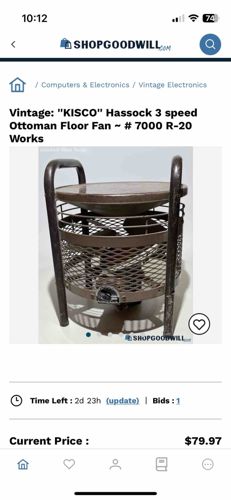
This item is a vintage "KISCO" Hassock 3-speed Ottoman Floor Fan, model #7000 R-20. Physically, the fan presents as a cylindrical unit with a diameter that appears to be roughly 18-24 inches, supported by four sturdy, bowed metal legs that extend upwards to form a handle-like structure on top, giving it the appearance of an ottoman or hassock. The main body of the fan is encompassed by a finely meshed metal cage or grill, likely made of steel, which encloses the fan blades, suggesting a protective measure. The color is a uniform, dark, likely original, bronze or brown, hinting at its age and perhaps original factory finish. There is a circular top surface, possibly also metal or a sturdy laminate, designed to serve as a surface for placement, reinforcing its ottoman functionality. A control knob for adjusting the fan speed (3-speed as indicated) is visible on the front lower portion of the meshed body. The overall construction appears robust and industrial, characteristic of appliances from the mid-20th century. Condition-wise, the fan exhibits visible patina and some wear consistent with a vintage item, including potential chipping or scratching on the painted metal surfaces, though no major damage like dents or cracks are immediately apparent from the image. The wire mesh grill seems intact, and the fan is stated to be in working condition, which is a significant quality indicator for vintage electronics. The 'KISCO' branding indicates the manufacturer, suggesting a period likely from the mid-century (1950s-1970s) when this style of fan was popular. The design prioritizes both functionality as a fan and utility as a piece of furniture, a unique aspect.
AI Appraisal Report
Upon examining the provided images and description of the KISCO Hassock 3-speed Ottoman Floor Fan (Model #7000 R-20), I can assess its current market value. The fan appears to be in good, original vintage condition. The dark bronze/brown finish and metal mesh construction are consistent with authentic mid-20th-century manufacturing from KISCO. The visible patina and minor surface wear are expected for an appliance of this age and do not significantly detract from its value; in fact, they contribute to its vintage character. A critical factor positively impacting its value is its stated working condition across all three speeds.
Market analysis shows a consistent demand for functional, mid-century modern decorative appliances. Comparable KISCO hassock fans in similar working condition have recently sold in the range of $125 to $225. The dual functionality as both a fan and a piece of furniture (an ottoman) enhances its appeal to collectors and designers. This particular model, with its distinctive bowed legs forming a top handle, is a desirable design.
However, this appraisal is based solely on visual information. A full authentication would require an in-person physical examination to verify the originality of the motor, wiring, and paint finish. I would also need to test the fan's operation myself to check for noise or mechanical issues and inspect the power cord for safety. Without such hands-on inspection and testing, the operational reliability and complete originality cannot be definitively confirmed.