AI estimate as of October 25, 2025 · verify with a professional before acting
AI-Generated · Verify before acting
Everything on this page is generated by AI for informational purposes only. AI can make mistakes — the AI may misidentify items or misattribute them (artist, maker, brand, designer, origin, era). This is not an official valuation and should not be used for insurance, sale, tax, estate, legal, or lending purposes — or any decision requiring a certified appraisal. It is not an authoritative claim about any person, brand, or rights holder — do not share or rely on it as a factual statement about a third party. Always consult qualified professionals before making financial decisions.
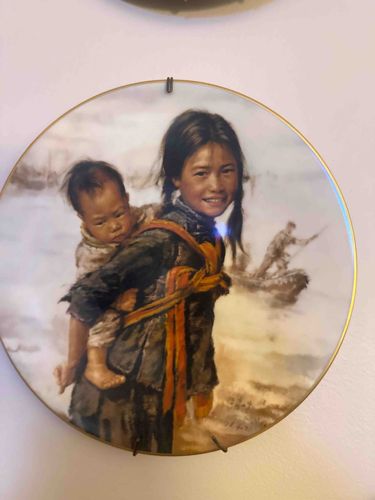
This item is a circular decorative collector's plate, appearing to be made of porcelain or fine ceramic, with a prominent gold-colored rim that suggests a gilded edge. The plate features a detailed, painted illustration depicting a young Asian girl with her hair styled in two braids, smiling slightly towards the viewer. She is carrying a baby on her back, secured by a broad sash or wrap that appears to be made of a textured, possibly woven fabric in shades of orange and brown. The girl is dressed in dark-colored, seemingly traditional or humble clothing, showing some wear or rustic texture. The baby's attire is lighter in color, possibly white or cream. The background of the illustration is soft and impressionistic, with muted tones of white, beige, and light blues, suggesting an outdoor, possibly cold or misty environment. There are faint, indistinct figures or shapes in the mid-ground to the right, which could be other individuals or elements of the landscape. The plate is displayed on a wall, held by a simple wire hanger with two visible clips at the top and bottom edge. There are no overt signs of damage, cracks, or chips visible on the plate's surface, and the colors of the illustration appear vibrant and well-preserved. The style of the painting suggests a realistic, perhaps sentimental, approach often found in collector's plates from the late 20th century. The craftsmanship appears to be of good quality, with fine detail in the figures' faces and expressions.
AI Appraisal Report
Based on my visual examination of the provided image, this decorative collector's plate, featuring a young Asian girl carrying a baby, appears to be in excellent condition. There are no visible chips, cracks, or significant wear to the gilded rim or the painted illustration. The colors are vibrant and well-preserved, suggesting it has been carefully stored or displayed. The painting style is typical of mass-produced collector's plates from the late 20th century, often sentimental and realistic.
However, it is crucial to note the limitations of appraising solely from images. I cannot definitively assess the authenticity of the plate in terms of its manufacturer or artist without direct physical examination. Marks on the reverse side of the plate, such as backstamps, manufacturer names, series numbers, or artist signatures, are essential for full authentication and proper identification. Without these, it is impossible to determine if it is part of a limited edition series or a widely produced decorative item. Physical inspection would also allow me to assess the material quality, weight, and glaze more accurately.
Market conditions for collector's plates, particularly those from the late 20th century, are generally soft. Most decorative plates, unless part of a highly sought-after, rare, or historically significant limited edition from a renowned manufacturer (e.g., 특정 Franklin Mint, Bradford Exchange issues with specific artists), have seen a significant decline in value. Demand is low, and rarity is often not a factor for general decorative plates like this one. Therefore, while visually appealing and in good condition, its market value as a collectible is relatively modest.
Factors that could significantly impact its value (positively) would be if it were identified as a rare piece by a known artist, part of a limited and historically significant series, and if accompanying provenance documentation (certificates of authenticity, original boxes) were available. Conversely, a lack of such identification keeps its value as a decorative item rather than a high-value collectible.
In-person examination would involve inspecting the reverse side for maker's marks and verifying the material. Provenance documentation would be needed for definitive authentication and to determine if it's a rare issue. Without these, my appraisal is based on its aesthetic appeal and the general market for similar decorative plates.