AI Appraisal Estimate

AI-generated estimates · not official valuations

From the user

What was submitted

Photo and notes provided by the user — not generated by AI

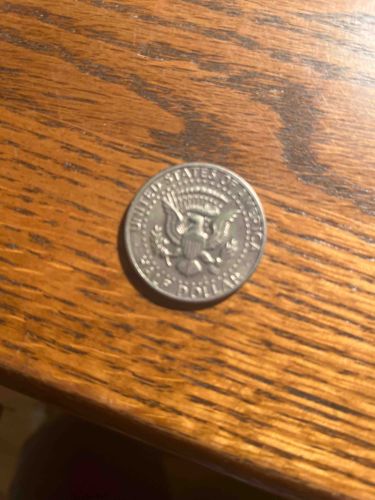
Submitted item photo
Submitted photo · May 28, 2026

User's notes

No additional notes provided.

AI analysis below

AI appraisal

AI analysis & estimate

AI-Generated · Verify before acting

Everything below is generated by AI for informational purposes only. AI can make mistakes — the AI may misidentify items or misattribute them (artist, maker, brand, designer, origin, era). This is not an official valuation and should not be used for insurance, sale, tax, estate, legal, or lending purposes — or any decision requiring a certified appraisal. It is not an authoritative claim about any person, brand, or rights holder — do not share or rely on it as a factual statement about a third party. Always consult qualified professionals before making financial decisions.

Read the full disclaimer

AI Identification

·Not independently authenticated·Verify before acting

United States Kennedy Half Dollar Coin (Reverse)

Coin

AI Estimated Value

·Not an official valuation·Verify before acting

$0.50 - $1.00

As of May 28, 2026

AI Item Analysis

·AI can make mistakes·Verify before acting
The item is a United States half dollar coin, specifically exhibiting the "reverse" side (tail side). The coin is circular and appears to be made of a silver-colored metallic alloy, consistent with the clad compositions used for half dollars after 1970. The design clearly features the Great Seal of the United States, depicting a heraldic eagle with a shield on its chest, an olive branch in its right talon, and arrows in its left. Above the eagle's head, there is a cluster of stars, and a banner is visible clutched in its beak, though the inscription is not discernable from this image. Around the top edge, the inscription "UNITED STATES OF AMERICA" is clearly legible. Below the eagle, the denomination "HALF DOLLAR" is visible. The surface of the coin shows signs of circulation, indicated by some light scuffing and minor wear on the raised elements, particularly on the eagle's wings and shield. There is no significant corrosion or deep scratches visible, suggesting a circulated but generally well-preserved condition for regular currency. The craftsmanship appears standard for mass-produced coinage. The exact year is not visible from this side, but the design indicates it is a Kennedy Half Dollar, which has been minted since 1964. Given the apparent composition, it is most likely from 1971 or later, as earlier versions contained higher silver content.

AI Appraisal Report

·AI can make mistakes·Verify before acting
Upon examining the reverse side of this United States Kennedy Half Dollar, I can confirm its authenticity based on the distinctive Great Seal of the United States design, which is characteristic of this series. The inscriptions "UNITED STATES OF AMERICA" and "HALF DOLLAR" are clearly legible and accurately placed. This design has been consistent on Kennedy Half Dollars since 1964. The apparent silver-colored metallic alloy suggests a clad composition, most commonly used from 1971 onwards; pre-1971 issues (1964 specifically) were 90% silver, and 1965-1970 issues were 40% silver. Without seeing the obverse for the date or edge for composition, a definitive year or silver content cannot be determined via this image alone. The coin is in a circulated but well-preserved condition, showing light wear on the higher points of the eagle's wings and shield, consistent with regular handling. There are no significant scratches, dents, or signs of corrosion that would severely detract from its value. In terms of market conditions, Kennedy Half Dollars, especially clad issues, are readily available and widely collected due to their historical significance but are generally not considered rare. Demand is steady among casual collectors and those accumulating sets. Given its circulated state, its value is primarily tied to its face value plus a slight numismatic premium for its collectibility rather than intrinsic metal value (unless it's a higher silver content issue). For full authentication and precise valuation, a physical examination is crucial. This would allow for: 1. **Date Verification:** To identify the specific year of mintage, which could impact value, especially if it's a key date or error variety. 2. **Edge Examination:** To determine the precise metallic composition (e.g., solid silver edge for 90%, faint copper line for 40%, or prominent copper line for clad issues), directly affecting intrinsic value. 3. **Weight and Diameter Measurement:** To confirm it meets official specifications. 4. **Luster Assessment:** To accurately grade the coin's condition and identify any subtle surface issues not visible in the image. Without these, the appraisal remains limited to visual features.

Get your items appraised

Instant estimates of your treasures with AI-powered appraisals

Browse More Appraisals