AI estimate as of July 25, 2025 · verify with a professional before acting
AI-Generated · Verify before acting
Everything on this page is generated by AI for informational purposes only. AI can make mistakes — the AI may misidentify items or misattribute them (artist, maker, brand, designer, origin, era). This is not an official valuation and should not be used for insurance, sale, tax, estate, legal, or lending purposes — or any decision requiring a certified appraisal. It is not an authoritative claim about any person, brand, or rights holder — do not share or rely on it as a factual statement about a third party. Always consult qualified professionals before making financial decisions.
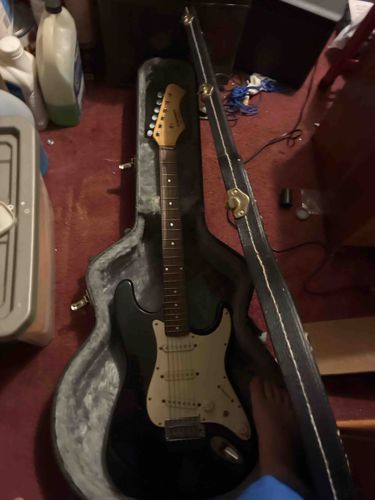
The item is an electric guitar, specifically a Stratocaster-style model, likely a beginner or intermediate level instrument. It features a solid body finished in a dark color, possibly black or dark blue, with a glossy sheen. The pickguard is a contrasting cream or off-white color, housing three single-coil pickups, typical of a Stratocaster. The bridge appears to be a vintage-style tremolo system, with six individual saddles and a visible tremolo arm insert. Control knobs, one volume and two tone, are also cream-colored, along with a five-way pickup selector switch. The neck is made of a light-colored wood, likely maple, with a fretboard that appears to be rosewood or a similar dark wood, featuring white dot inlays. The headstock is the classic Stratocaster shape, with tuners arranged in a 6-in-line configuration. While the brand name on the headstock is not perfectly clear, it has a flowing script logo. The guitar is currently housed in a black hardshell case with a grey plush interior lining, which shows some wear and tear, including scuff marks and dust. The case also has gold-toned latches, although one appears to be disengaged or in disrepair. Visible condition issues on the guitar itself include some dust accumulation, particularly on the pickguard and around the bridge, suggesting it may not have been used or cleaned recently. There are no obvious signs of major damage or repairs from the provided image, but minor surface scratches or dings would be expected with regular use on an instrument of this type. The overall construction appears standard for this style of guitar, indicating a mass-produced item. The visible components suggest functional integrity, although a full assessment would require closer inspection and testing. The model and manufacturing details are not explicitly identifiable without clearer markings, but it strongly resembles many entry-to-mid-level Stratocaster-inspired guitars produced from the late 20th century to the present.
AI Appraisal Report
I have examined the provided image of a Stratocaster-style electric guitar. Based on my visual assessment, this appears to be a mass-produced, entry to mid-level instrument. The overall condition, while showing some dust and minor scuffing on the case, suggests functional integrity, though an in-person inspection would be needed to confirm this. There are no obvious signs of major damage or repairs visible in the image. Authenticity is challenging to ascertain definitively from a single image. While the headstock has a flowing script logo, typical of many brands, without a clear view, I cannot identify the manufacturer. It strongly resembles many 'Strat-copy' guitars prevalent in the market.
Market conditions for such guitars are competitive, with a wide range of new and used instruments available. Comparable instruments from known brands like Squier, Yamaha, or various house brands typically retail new between $200-$400, and used for less, depending on condition and model. Demand for entry-level electric guitars is consistent but not indicative of rarity, as these are commonly produced. Factors significantly impacting value include the actual brand and model (which remains unknown), the playability, electronics functionality, and any hidden damage not visible in the image. The hardshell case, despite its wear, adds some value.
Limitations in authenticity verification are significant. Without a clear view of the headstock logo, serial number, or other identifying marks, I cannot confirm the specific make or model. An in-person examination would allow for inspection of fret wear, neck relief, electronics performance, and overall structural integrity. Provenance documentation (receipts, warranty cards) would aid in verifying originality and ownership history. Scientific testing is generally not required for guitars of this type unless alterations or specific wood types need confirmation.