These notes were written by the person who submitted this item. Appraiser.AI has not verified them, and the AI's identification and estimate may rely on them.
AI Estimated Value
Not an official valuation
$60 - $100
AI estimate as of November 22, 2025 · verify with a professional before acting
AI-Generated · Verify before acting
Everything on this page is generated by AI for informational purposes only. AI can make mistakes — the AI may misidentify items or misattribute them (artist, maker, brand, designer, origin, era). This is not an official valuation and should not be used for insurance, sale, tax, estate, legal, or lending purposes — or any decision requiring a certified appraisal. It is not an authoritative claim about any person, brand, or rights holder — do not share or rely on it as a factual statement about a third party. Always consult qualified professionals before making financial decisions.
This analysis also relies on unverified notes provided by the user, which may be incomplete or inaccurate and could affect the result.
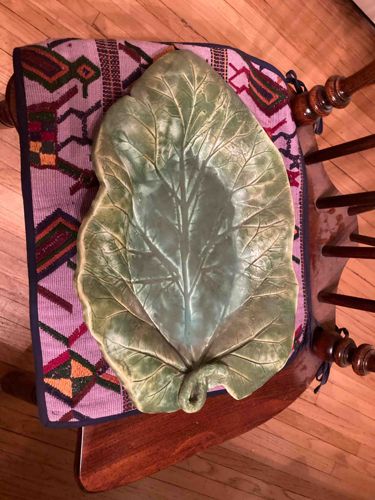
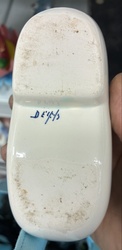
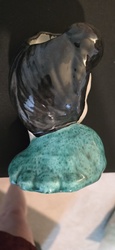
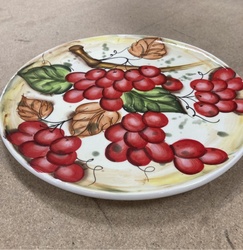
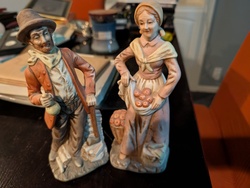
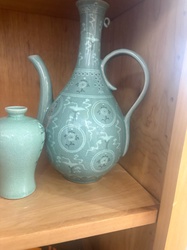
This is a decorative ceramic dish or platter, approximately 15 inches by 10 inches, molded in the realistic form of a large leaf. The dish features a naturalistic green and blue-green glaze that exhibits variations in tone, mimicking the organic coloring of a living leaf, with lighter green edges and a deeper, more iridescent blue-green towards the center and along the veining. The ceramic material appears to be earthenware, likely hand-formed or molded. Prominent raised veins are visible across the entire surface of the 'leaf,' adding to its three-dimensional quality and tactile appeal, and serving as natural dividers within the dish's surface. One end of the dish tapers into a curled stem-like element, enhancing the botanical realism. The edges of the leaf are slightly ruffled and raised, providing a shallow basin for serving or display. There's a subtle sheen to the glaze, suggesting it's either semi-gloss or satin. There are no obvious chips, cracks, or repairs visible from the provided image, indicating good overall condition. Patina, if any, is indistinguishable from the variable glaze unless a closer inspection were made. There are no discernible maker's marks or signatures visible from this angle. The craftsmanship appears to be of good quality, with attention paid to replicating natural leaf textures and forms, suggesting it could be a studio pottery piece or from a manufacturer specializing in botanical-themed ceramics. Its style suggests a mid-20th century to contemporary period, embracing organic forms.
AI Appraisal Report
Based on my visual examination of the provided image, this Leaf-Shaped Ceramic Dish/Platter, measuring approximately 15 x 10 inches, appears to be in very good condition. I detect no obvious chips, cracks, or repairs, which is a significant factor in maintaining its value. The naturalistic green and blue-green glaze with its tonal variations and the raised veining demonstrate good craftsmanship, suggesting either studio pottery or a quality manufacturer specializing in botanical forms. The tapered, curled stem element further enhances its decorative appeal and realism. Its aesthetic aligns with mid-20th century to contemporary organic design trends.
Market conditions for decorative ceramic platters of this style are generally stable. Comparable items, often referred to as 'majolica-style' or 'leafware,' from established but not necessarily famous makers, typically sell in the $50-$120 range. Pieces by well-known studio potters or specific manufacturers might command higher prices, but without a visible maker's mark or signature, it's difficult to attribute it to a specific, highly collectible source. Demand for such charming and functional decorative pieces is consistent, though they are not considered rare. The main value drivers here are its excellent condition, appealing design, and decent size.
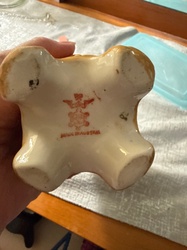
A significant limitation in my authentication and precise valuation is the lack of a visible maker's mark. A physical inspection would be crucial for this, allowing me to examine the base for any impressed or painted signatures, assess the exact type of ceramic (earthenware vs. stoneware), and determine the glaze quality firsthand. Provenance documentation, detailing its history of ownership, would also be beneficial for full authentication. Without these, the appraisal remains largely based on its decorative appeal and condition as a generic, well-made ceramic piece.