AI Appraisal Estimate

AI-generated estimates · not official valuations

From the user

What was submitted

Photo and notes provided by the user — not generated by AI

Submitted item photo
Submitted photo · May 19, 2026

User's notes

No additional notes provided.

AI analysis below

AI appraisal

AI analysis & estimate

AI-Generated · Verify before acting

Everything below is generated by AI for informational purposes only. AI can make mistakes — the AI may misidentify items or misattribute them (artist, maker, brand, designer, origin, era). This is not an official valuation and should not be used for insurance, sale, tax, estate, legal, or lending purposes — or any decision requiring a certified appraisal. It is not an authoritative claim about any person, brand, or rights holder — do not share or rely on it as a factual statement about a third party. Always consult qualified professionals before making financial decisions.

Read the full disclaimer

AI Identification

·Not independently authenticated·Verify before acting

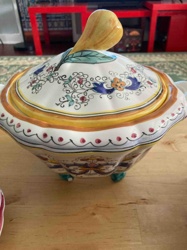
La Musa Italian Majolica Serving Platter

Antique & Vintage Ceramic Tableware

AI Estimated Value

·Not an official valuation·Verify before acting

$45 - $85

As of May 19, 2026

AI Item Analysis

·AI can make mistakes·Verify before acting
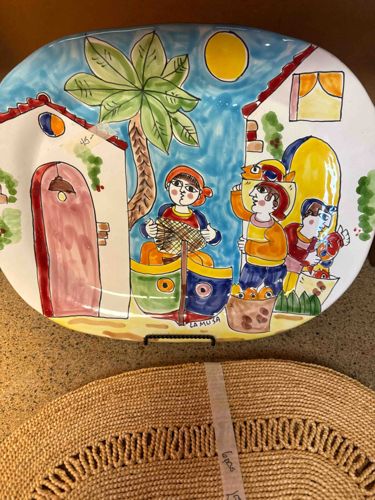
A vintage oval ceramic serving platter featuring the distinctive folk-art style of the Ceramiche La Musa studio based in Sicily, Italy. The piece displays a vibrant, hand-painted narrative scene depicting a coastal village life, likely Mediterranean in inspiration. In the center, a woman is seated in a dual-colored fishing boat, while a tall palm tree rises behind her against a blue sky with a bright yellow sun. To the right, male figures are shown carrying baskets of oranges and fish, emphasizing a harvest theme. The platter is constructed from red clay earthenware with a white tin-glaze (majolica) base. Notable for its bold, black-outlined figures and primary color palette of yellow, red, blue, and green, the piece includes the signature 'LA MUSA' prominently at the bottom center of the illustration. The style is mid-to-late 20th century, characterized by its playful, naive aesthetic reminiscent of Picasso or Matisse's later works. Condition-wise, the platter appears well-preserved with no major chips or cracks visible on the face, though there is a small price tag/label residue on the left house. The glaze has a high-gloss finish typical of Italian decorative export ware, and the artisanal hand-painted nature ensures each piece is unique. This specific design is highly collectible for those seeking Sicilian terracotta and traditional Italian kitchenware.
AI Appraisal Report

·AI can make mistakes·Verify before acting
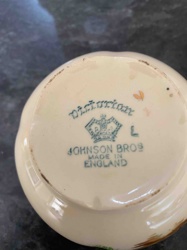
Based on my visual examination of the provided images, this is a charming example of Italian majolica produced by the Ceramiche La Musa studio in Sicily within the mid-to-late 20th century. The piece exhibits the classic hallmarks of La Musa ware: a red earthenware body covered in an opaque white tin glaze, featuring a vibrant, hand-painted narrative scene rendered in a naive, folk-art style with bold black outlines and primary colors. The signature 'LA MUSA' is prominently visible within the design, which aligns with verified examples from this maker. The coastal motif, featuring harvest figures and distinct Sicilian architecture, is highly characteristic of their export line. Condition appears very good for its vintage; the high-gloss finish remains intact, and I observe no catastrophic chips or hairline cracks on the decorative face. The visible adhesive residue on the left side is a minor surface issue easily remedied. Market conditions for mid-century Italian export ceramics have remained stable, though they are generally valued as decorative objects rather than high-value fine art. Comparables of similar size (likely 12-16 inches) and complexity typically sell in the $50-$80 range on sites like Etsy and eBay, occasionally reaching higher if part of a larger set. Authentication via image is limited. While the style and signature are visually consistent with La Musa, a physical inspection is required to check for hidden restoration work, confirm the weight and resonance of the clay body (to rule out hairline cracks not visible to the eye), and examine the verso for any secondary maker's marks or import stamps. Without checking the rim for microscopic 'fleabite' chips common in soft earthenware, this valuation assumes excellent structural integrity.

Get your items appraised

Instant estimates of your treasures with AI-powered appraisals

Browse More Appraisals