AI estimate as of September 27, 2025 · verify with a professional before acting
AI-Generated · Verify before acting
Everything on this page is generated by AI for informational purposes only. AI can make mistakes — the AI may misidentify items or misattribute them (artist, maker, brand, designer, origin, era). This is not an official valuation and should not be used for insurance, sale, tax, estate, legal, or lending purposes — or any decision requiring a certified appraisal. It is not an authoritative claim about any person, brand, or rights holder — do not share or rely on it as a factual statement about a third party. Always consult qualified professionals before making financial decisions.
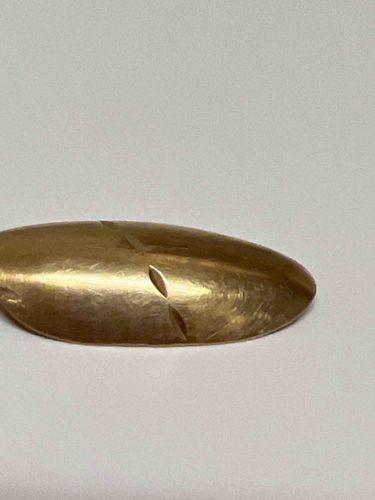
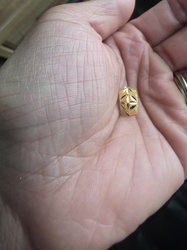
This item appears to be a decorative element, likely a component for a pin or brooch, crafted from what looks to be polished brass or a similar golden-hued metal alloy. It features an elongated, oval, or teardrop shape, with a convex top surface that gives it a slight dome-like profile. The material exhibits a bright, reflective golden color, indicative of brass or possibly gold-plated metal. The surface texture is somewhat irregular, showing fine brush strokes or light scuffing, suggesting either a hand-finished quality or general wear consistent with age and use. A prominent decorative feature is present on the top surface: two incised, elongated ovals or almond shapes, arranged perpendicularly to each other, forming a cross-like pattern near the center. These incisions are notable for their clean edges and consistent depth, suggesting precise craftsmanship, possibly achieved through stamping or engraving. While no specific maker's marks or signatures are visible in the provided image, the craftsmanship of the incised details suggests a certain level of manufacturing quality. The overall aesthetic implies a vintage or antique style, potentially from the mid-20th century, given the material and design characteristics often associated with costume jewelry of that period. Visible condition issues include minor surface abrasions and possibly a light patina developing in some recessed areas, typical for brass items. The item's primary function would likely have been as a decorative accent for clothing or accessories, possibly as one component of a larger jewelry piece. The form factor is generally sleek and aerodynamic. The polished nature of the metal and the reflective qualities add to its allure.
AI Appraisal Report
Upon visual examination of the provided image, I assess this Brass Sand Dollar Pin/Brooch Element to be in good, used condition. The reflective golden hue is consistent with polished brass or a similar alloy, and while there are minor surface abrasions and scuffing, these appear consistent with age and gentle wear, not significant damage. The incised oval details are clear and well-defined, indicating a manufacturing process that produced consistent results, likely stamping or engraving, which suggests a mass-produced item rather than a unique handmade piece. Authenticity as a vintage decorative component is highly probable given the material and design, common in mid-20th century costume jewelry.
Market conditions for standalone, unsigned brass jewelry components are generally low. Comparables would include other vintage brass findings or costume jewelry elements. Demand for such an item as a collectible is minimal, and rarity is not a factor; similar components were produced in large quantities. The absence of a maker's mark significantly impacts value, placing it squarely in the costume jewelry findings category. Factors that would increase value, such as precious metal content, gemstone inclusions, or a recognized designer, are not present here. The primary value lies in its potential for re-use in crafting or repair.
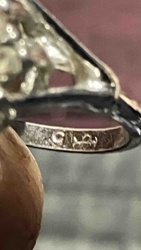
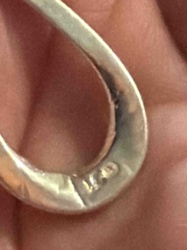
Without physical inspection, I cannot confirm the exact metal composition (e.g., distinguishing between solid brass, brass-plated base metal, or gold-filled/plated without hallmark). An in-person examination would allow for tactile inspection of surface finishes and precise measurement. Scientific testing, such as XRF analysis, would be necessary for definitive metal content verification. Provenance documentation, though unlikely for such a piece, would confirm its original context or designer if applicable. Based on visual information alone, I am confident in appraising this as a decorative brass element for costume jewelry.