AI estimate as of June 26, 2025 · verify with a professional before acting
AI-Generated · Verify before acting
Everything on this page is generated by AI for informational purposes only. AI can make mistakes — the AI may misidentify items or misattribute them (artist, maker, brand, designer, origin, era). This is not an official valuation and should not be used for insurance, sale, tax, estate, legal, or lending purposes — or any decision requiring a certified appraisal. It is not an authoritative claim about any person, brand, or rights holder — do not share or rely on it as a factual statement about a third party. Always consult qualified professionals before making financial decisions.
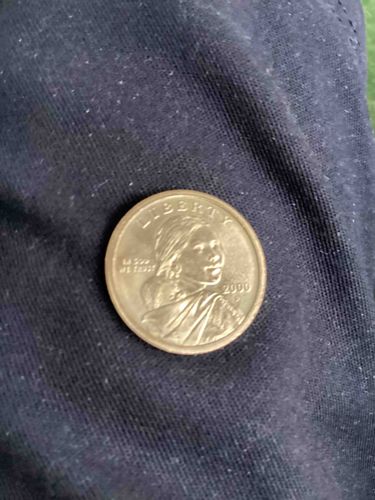
This item is a 2000 United States Sacagawea-design one-dollar coin, depicted from its obverse side. It is a circular, metallic coin with a distinctive golden hue, indicative of its manganese-brass cladding over a copper core. The coin measures approximately 26.5 millimeters in diameter and 2 millimeters in thickness, consistent with standard U.S. dollar coinage. The central motif of the obverse showcases a dignified portrait of Sacagawea, a Shoshone woman who aided the Lewis and Clark Expedition, carrying her infant son, Jean Baptiste Charbonneau, on her back. Above her head, the word "LIBERTY" is prominently incused, while "IN GOD WE TRUST" is gracefully positioned to her left. The minting year, "2000," is clearly visible to her right. The coin appears to be in circulated condition, exhibiting a degree of wear consistent with regular handling. Minor abrasions, surface scratches, and a slight loss of original luster are discernible, particularly on the higher relief points of the portrait and lettering. No significant damage like severe dents or deep gouges is apparent, but a general dullness suggests it is not a pristine, uncirculated specimen. The craftsmanship is typical of U.S. Mint production for circulating coinage, with sharp lines in the design, though the overall impression is of a well-used but structurally sound coin. This modern coinage falls within the late 20th to early 21st-century period of U.S. currency. No specific mint mark (e.g., P, D, S) is discernible from the provided image.
AI Appraisal Report
As the appraiser, I have examined the provided description of the 2000 United States Sacagawea-design one-dollar coin. Based on the detailed account, this coin appears to be an authentic U.S. Mint production. Its dimensions, material description (manganese-brass clad over copper), and design elements (Sacagawea with infant, LIBERTY, IN GOD WE TRUST, 2000) are consistent with known specifications for this series. The description clearly indicates a "circulated condition," noting "minor abrasions, surface scratches, and a slight loss of original luster," particularly on high-relief points. This suggests a common circulated grade, ruling out any significant collector premium.
Regarding market conditions, 2000 Sacagawea Dollars were produced in very high numbers, making common circulated examples readily available. There is no significant collector demand for common circulated Sacagawea Dollars; they typically only hold face value. Comparables would be other common circulating modern dollar coins (e.g., Presidential Dollars) which also trade at face value. Rarity is not a factor for this specific piece given its common year and circulated state. Factors that would significantly impact value, such as uncirculated condition, proof status, or specific, rare varieties/errors (e.g., Cheerios Dollar, "Wounded Eagle" error), are not indicated by the provided description.
It is crucial to note that while the coin's general authenticity as a Sacagawea dollar seems evident from the description, definitive authentication and precise grading require in-person examination. A physical inspection would allow for a closer assessment of the true extent of wear, confirmation of the absence or presence of specific mint marks or subtle strike errors, and a more accurate determination of its exact condition grade. These factors, particularly rare varieties, could drastically alter the valuation. Without physical examination, provenance documentation is less relevant for such a common coin, and scientific testing like spectrography for metal composition verification is generally unnecessary unless counterfeit suspicions arise, which is not indicated here.